
Resume Skills: What to List and How to Prove Them
Show contents

The best resume skills are the ones the job ad asks for and that you can prove with an example. In practice that means a short, grouped list of hard skills (tools, methods, languages) in a skills section, with your soft skills shown through results in your experience bullets. A long list of adjectives does not count.
Employers are clear about what they look for. In the NACE Job Outlook 2025 survey, nearly 90% of responding employers said they look for evidence of problem-solving skills on a resume, and nearly 80% look for teamwork. The key word there is evidence. This guide shows you which skills to put on a resume, how to pick them for each application, and how to back every one of them up.
What counts as resume skills?
A skill is something you can do, at a level someone else could check. That simple test removes a lot of noise. "Hardworking" is a trait. "Excel pivot tables" is a skill. "Motivated" is a feeling. "Writing weekly client reports" is a skill you can show.
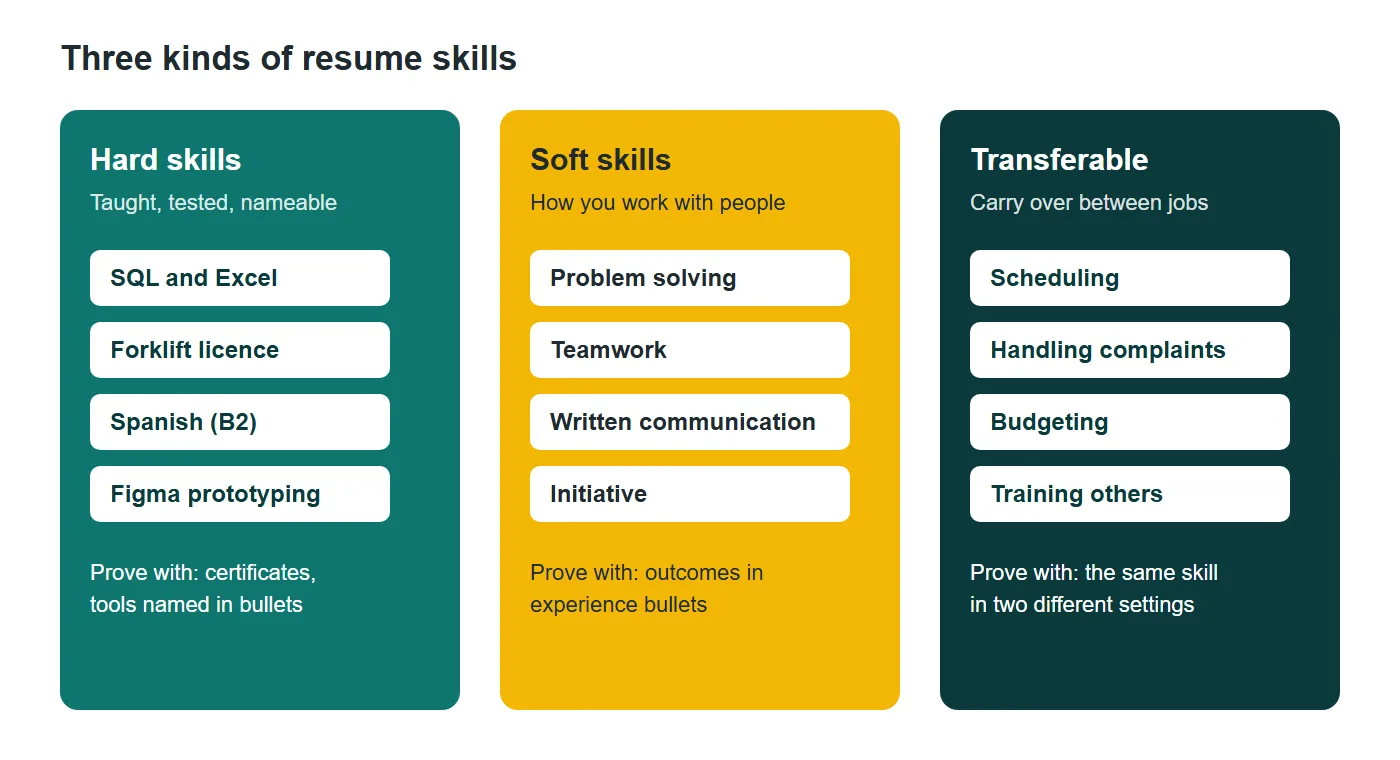
Most skills fall into three groups, and each one belongs in a slightly different place on the page:
- Hard skills are taught and testable: software, programming languages, machines, methods, licences and spoken languages. They go in your skills section, and the strongest ones also appear in your bullets.
- Soft skills describe how you work with people and problems: communication, teamwork, problem solving, initiative. They are best shown in experience bullets, because a claim alone is easy to make and hard to believe.
- Transferable skills are either kind, as long as they move with you between jobs. Scheduling, handling complaints and budgeting work in a cafe, a hospital and an office.
If you want a neutral vocabulary for skills, the US Department of Labor's O*NET database groups essential skills into foundational areas such as reading comprehension, writing, speaking and mathematics, and ways of working such as critical thinking, active learning and monitoring. Its definitions are precise. Critical thinking, for example, is "using logic and reasoning to identify the strengths and weaknesses of alternative solutions." That wording is far more useful in an interview than "good thinker".
Our view: most resumes list too many soft skills and too few hard ones. Soft skills matter enormously, as the NACE data shows, but they persuade only when attached to a result. Name the tools in your skills section and let the bullets do the talking about character.
The best skills to put on a resume, according to employers
No list fits every job, but survey data tells you which qualities recruiters scan for first. Here is what employers in the NACE Job Outlook 2025 survey said they look for on candidates' resumes. The survey drew 237 employer responses, and NACE published the results on December 9, 2024.
| Attribute employers look for | Share of employers | How to show it on a resume |
|---|---|---|
| Problem solving | Nearly 90% | A bullet that names the problem, your fix and the result |
| Teamwork | Nearly 80% | A shared project with your specific part and its outcome |
| Written communication | At least 70% | Reports, documentation or content you wrote, and who used it |
| Initiative | At least 70% | Something you started without being asked |
| Strong work ethic | At least 70% | Reliability over time: tenure, workload, deadlines met |
| Technical skills | At least 70% | Named tools and methods in the skills section and bullets |
| Verbal communication, flexibility, analytical skills | More than two-thirds | Presentations, role changes handled, analysis that led to a decision |
Two things stand out. First, almost everything on that list is a soft skill, yet the right-hand column is all evidence. Second, "technical skills" sit in the same band as initiative. Employers want both kinds, which is why a strong resume has a tidy hard skills list and proof of soft skills in the experience section.
Tip: treat the table as a checklist for your experience bullets, not for your skills list. If no bullet shows problem solving, add one before you add the words "problem solving" anywhere.
Beyond these broad attributes, the best skills to add to a resume are the specific ones in the job ad. That is where the next section comes in.
How to choose skills for each job ad
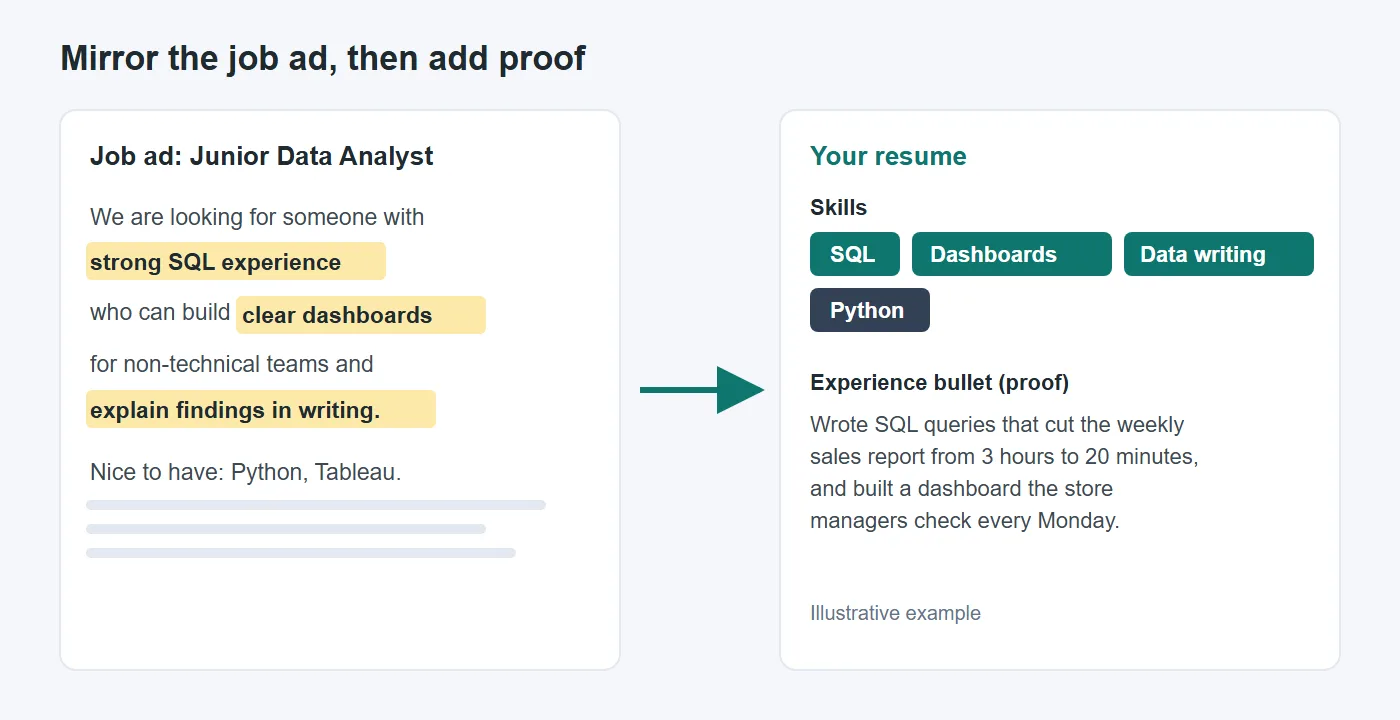
The fastest way to pick resume skills is to let the employer tell you. Harvard's career office puts it simply: "your resume should reflect the types of skills the employer would value." Here is the routine we recommend, and it takes about ten minutes per application.
- Copy the job ad into a document. Highlight every tool, method, qualification and repeated phrase.
- Sort the highlights. Split them into must-haves (in the requirements) and nice-to-haves (in "bonus" or "preferred" lines).
- Match honestly. Keep only the skills you genuinely have. Prospects warns: "Don't exaggerate your abilities, as you'll need to back up your claims at interview."
- Use their wording. If the ad says "stakeholder management", do not write "dealing with people". Applicant tracking systems (software that stores and searches applications) and human readers both match on familiar terms.
- Add proof. For each must-have, make sure at least one experience bullet shows it in action.
A word on keyword stuffing. Some guides suggest pasting every phrase from the ad into your resume, sometimes in white text. Do not. Recruiters read the document, and Greenhouse's own candidate FAQ reminds applicants that resume parsing "can make mistakes," which is exactly why clarity beats tricks. Our ATS-friendly resume guide covers what parsers really need.
If the same skill keeps appearing in ads you like but not on your resume, that is useful information too. It is a short list of what to learn next.
Resume skills examples by job
These examples show the kind of mix that works: a handful of specific hard skills, plus the soft skills that matter most in that role, which you then prove in bullets. Use them as a starting point and swap in the exact terms from your target ads.
| Role | Hard skills to list | Soft skills to prove in bullets |
|---|---|---|
| Customer service | Zendesk or Freshdesk, CRM data entry, live chat, typing speed | Calm under pressure, complaint handling, clear explanations |
| Teacher | Lesson planning, Google Classroom, assessment design, safeguarding training | Classroom management, parent communication, patience |
| Nurse | Patient assessment, medication administration, electronic health records, BLS certification | Teamwork across shifts, empathy, prioritising under pressure |
| Software engineer | Languages and frameworks you have shipped with, Git, testing, cloud services | Code review, cross-team collaboration, problem solving |
| Data analyst | SQL, Excel or Google Sheets, Python or R, a BI tool such as Tableau | Explaining findings to non-technical teams, curiosity |
| Graphic designer | Figma, Adobe Illustrator and Photoshop, typography, print preparation | Taking feedback, client communication, deadlines |
| Retail or hospitality | Point-of-sale systems, cash handling, stock control, food hygiene certificate | Teamwork at peak hours, upselling, reliability |
For full worked examples, browse our resume examples, or the CV examples if you are applying in the UK, Europe or another market that expects a CV.
What about "computer literacy" on a CV?
"Computer literate" tells a recruiter almost nothing, because nearly every applicant for an office job uses a computer every day. Replace it with the tools and the level: "Excel (pivot tables, XLOOKUP), Google Workspace, Canva". Prospects describes the skills section as the place to mention "the foreign languages you speak and the IT packages you can competently use", which is exactly that idea.
Skills when you have little experience
If you are a student or after your first job, your resume skills still need sources. The National Careers Service suggests focusing "on skills you've learned through projects, work experience or volunteering." Our student resume examples and the guide to a resume for your first job show how to turn coursework and part-time work into credible skills. Hobbies can help too, as our guide to hobbies on a resume explains.
How to list skills on a resume
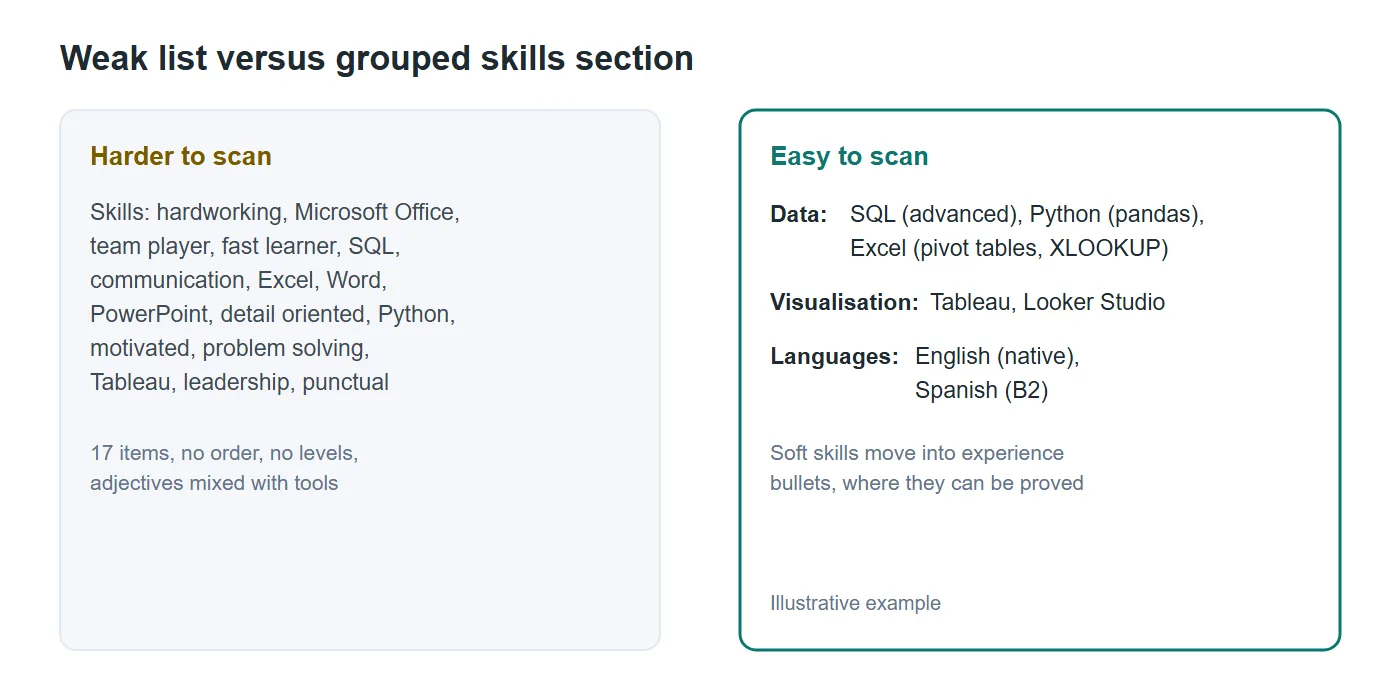
Format matters because recruiters skim. Grouped resume skills are easier to read and easier to parse than a long comma-separated list.
Use these rules for the section itself:
- Title it "Skills". Standard headings help both people and parsers find the section.
- Group by type. For example Data, Design, Languages, Certifications. Three or four groups is plenty.
- Keep it short. Eight to fifteen specific items usually cover a role without padding.
- Add levels in words, not graphics. "Spanish (B2)" or "Python (intermediate)" works. Star ratings and progress bars do not, and Greenhouse lists graphics among the causes of an unsuccessful resume parse.
- Avoid tables and columns for the list. The same Greenhouse article names "complex resumes with tables" and "a columned layout" as parsing risks.
Placement depends on your profile. Most people should put skills after experience. If you are changing careers, or the role is strongly technical, a skills section near the top, directly under your summary, helps the reader connect your background to the new role quickly. A resume summary that names your two strongest skills is a good bridge.
Our resume builder has a dedicated skills section that stays as plain, selectable text in the exported PDF. If you need a European-style document, the same applies in the CV maker.
Prove your skills with action verbs and results
A skills list makes a claim. Your experience bullets prove it. Harvard's guide recommends "using action verbs and quantifiable results," and warns against passive language. The simplest pattern is: action verb, what you did, measurable result.
| Skill you want to prove | Useful action verbs | Example bullet (illustrative) |
|---|---|---|
| Problem solving | Diagnosed, resolved, redesigned, streamlined | Redesigned the returns form, cutting incomplete requests by a third |
| Teamwork | Collaborated, coordinated, supported, partnered | Coordinated with two warehouse teams to clear a 400-order backlog in a week |
| Leadership | Led, trained, mentored, delegated | Trained four new starters, who all passed probation |
| Written communication | Wrote, documented, drafted, edited | Wrote the onboarding guide now used for every new hire |
| Analytical skills | Analysed, forecast, measured, modelled | Analysed churn data and found the two plans driving most cancellations |
| Initiative | Launched, proposed, introduced, built | Proposed and launched a weekly FAQ email that reduced repeat tickets |
Replace the example numbers with your own real ones. If you do not have exact figures, use honest approximations you can explain ("about 60 tickets a day") rather than invented precision.
Notice how each bullet makes the soft skill visible without naming it. That is the whole trick. Once your bullets carry the proof, the words in your skills section stop sounding like claims and start sounding like a summary.
Skills section mistakes and a final check
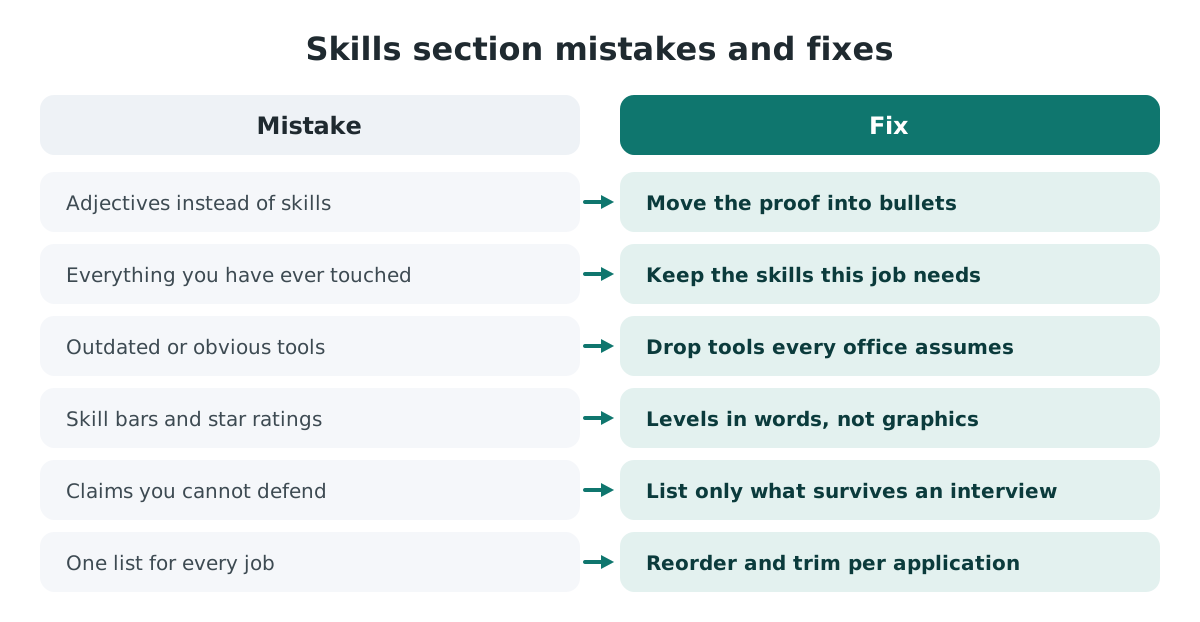
Most weak lists of resume skills fail in the same few ways:
- Adjectives instead of skills: "hardworking, passionate, team player". Move the proof into bullets and cut the adjectives.
- Everything you have ever touched: a 30-item list hides the five skills that matter for this job.
- Outdated or obvious tools: "Microsoft Word" or "email" adds nothing for most office roles.
- Skill bars and star ratings: they are unreadable to parsers and meaningless to people. What does four out of five stars in Excel mean?
- Claims you cannot defend: anything listed is fair game for an interview question or a test task.
- One list for every job: reorder and trim the section for each application, using the job ad routine above.
Before you send it, check that every must-have skill from the ad appears on the page in the employer's own words, that at least one bullet proves each of your top three skills, and that the section is plain text in a clean font. Our guide to the best resume font and size covers that last part.
When it all lines up, build the document in the resume builder and download the PDF, with no sign-up and your data kept in your browser. Then reuse the same skills in a matching letter from the cover letter generator, and if the new offer arrives, the resignation letter tool will help you leave your current job on good terms. For the full structure from header to final section, see how to write a resume.
Frequently asked questions
What skills should I put on my resume?
Put the hard skills the job ad asks for and that you genuinely have, such as tools, methods, certifications and languages, in a short grouped skills section. Show soft skills like problem solving and teamwork through results in your experience bullets.
How many skills should a resume have?
Eight to fifteen specific skills usually cover a role without padding. Fewer, well-chosen skills that match the job ad are more convincing than a long list.
What is the difference between hard skills and soft skills?
Hard skills are taught and testable, like SQL, Spanish or forklift operation. Soft skills describe how you work with people and problems, like communication and teamwork. Both matter, but soft skills need proof in your bullets to be believed.
Which skills do employers look for most?
In the NACE Job Outlook 2025 survey, nearly 90% of responding employers looked for evidence of problem-solving skills on resumes and nearly 80% looked for teamwork. Written communication, initiative, work ethic and technical skills mattered to at least 70%.
Where should the skills section go on a resume?
For most people, after the experience section. Career changers and applicants for strongly technical roles can place it near the top, directly under the summary.
Should I rate my skills with stars or bars?
No. Ratings are vague for people and can confuse parsers, since Greenhouse lists graphics among the causes of an unsuccessful resume parse. Write levels in words instead, such as "Spanish (B2)" or "Python (intermediate)".
Is "computer literate" a good skill for a CV?
Not on its own. Name the tools and your level instead, for example "Excel (pivot tables, XLOOKUP), Google Workspace". Prospects describes the skills section as the place for the IT packages you can competently use.
Sources
- NACE: What are employers looking for when reviewing college students' resumes? (Job Outlook 2025, December 9, 2024)
- O*NET OnLine (US Department of Labor): Browse by essential skills
- Harvard FAS Mignone Center for Career Success: Create a strong resume
- Prospects: How to write a CV
- National Careers Service (GOV.UK): How to write a CV
- Greenhouse Support: Unsuccessful resume parse
- Greenhouse Support: MyGreenhouse FAQ for candidates