
Hobbies on Resume: When They Help and How to List Them
Show contents

Listing hobbies on a resume helps only when a hobby proves something the employer already wants: a skill from the job ad, a trait the role depends on, or a link to the industry. If it does none of those, leave it out and give the space to your experience. That is the short answer, and the rest of this guide shows you how to apply it line by line.
Career services on both sides of the Atlantic agree on the principle. The UK National Careers Service says you can include interests and hobbies "that show some of the skills you have", and Prospects is blunter: if you have no relevant hobbies, "leave this section out." We agree, and we would add one rule of our own. A hobby earns its line only when you can attach a concrete detail to it.
Should you put hobbies on a resume?
Most of the time, listing hobbies on your resume is optional. Recruiters read a resume to answer one question: can this person do the job? Your experience, results and skills answer it. Interests come last because they answer a smaller question: what else might this person bring?
That smaller question matters more in some situations than others. It matters a lot when you are a student or a recent graduate with little paid work, when you are changing careers and your hobby is the bridge, or when the company openly hires for culture and community. It matters very little when you have ten years of relevant experience and a full page of results.
Harvard's career office treats interests the same way. Its resume guide mentions that technical skills, language proficiency and "personal interests can be listed" in a closing section, after the material that carries the application. In other words, interests are a garnish, not the meal.
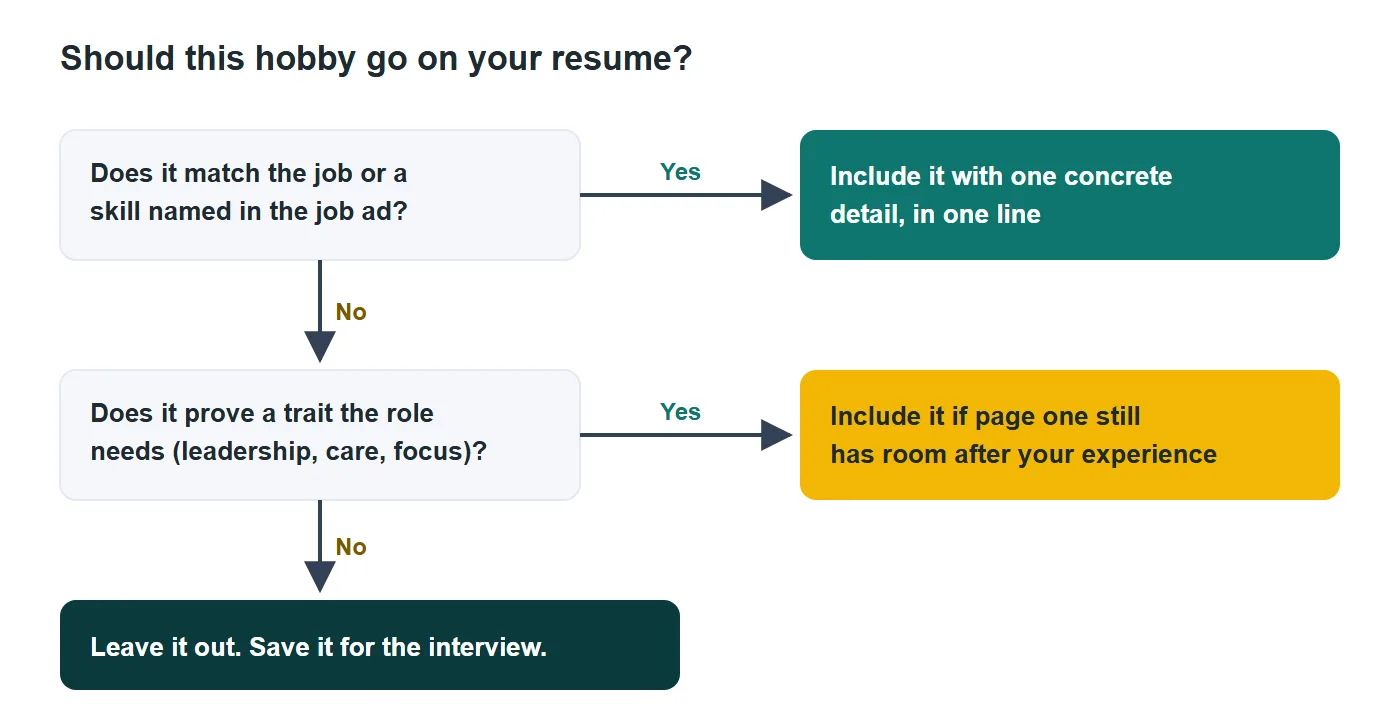
Here is our honest take. Many guides list "50 great hobbies for a resume" as if the hobby itself were the point. It is not. Two people can both write "chess", and one line is filler while the other is evidence. The difference is always the detail you attach, which is why the next sections focus on proof rather than on picking a fashionable pastime.
When hobbies and interests help, and when they hurt
Hobbies on a resume work in your favour in four situations:
- The hobby is the job in miniature. A developer who maintains an open-source library, a marketer who runs a niche newsletter, a chef applicant who enters baking competitions. The hobby is direct evidence of skill.
- It fills an experience gap. Students and career changers can show responsibility through a club role, a volunteer post or a team captaincy. The National Careers Service gives exactly this example: a sports team captain "demonstrates leadership and organisation skills."
- It matches the employer's world. An outdoor clothing brand will read "trail running, 3 ultramarathons" differently from a bank.
- It starts a conversation. A specific interest hands the interviewer an easy, friendly first question, and gives you a topic you can talk about with real energy.
They work against you in three situations. The first is generic filler. Prospects warns that "'socialising', 'listening to podcasts' and 'reading' aren't going to catch a recruiter's attention." The second is space theft: if interests push your best result onto page two, the trade is bad. The third is the one few guides mention, which is bias.
The research nobody quotes. Sociologist Lauren Rivera interviewed 120 employers at elite professional service firms. In Hiring as Cultural Matching (American Sociological Review, 2012) she found that evaluators sought candidates who were "culturally similar to themselves in terms of leisure pursuits, experiences, and self-presentation styles." Hobbies are read as signals of fit, and that cuts both ways.
What should you do with that finding? Not hide who you are, but be deliberate. A hobby is read through the reader's own life. So choose interests that you can connect to the work, and phrase them around what you did rather than around status. "Coached an under-12 football team for two seasons" travels well across almost any office. "Polo" tells the reader more about your background than about your ability.
Best hobbies for a resume, by the skill they prove
There is no universal list of good hobbies for a resume, but there is a useful way to sort them: by the skill a recruiter can infer. Use the table below to spot which of your real interests already points at something in the job description. Then pick one or two, never six.
| Hobby or interest | Skill it can signal | Fits roles like | Detail that makes it believable |
|---|---|---|---|
| Team sport captain or coach | Leadership, organisation | Management, sales, operations | Squad size, seasons, a league result |
| Long-distance running, cycling | Discipline, goal setting | Project work, consulting, sales | Training plan length, events finished |
| Coding side projects | Technical skill, self-teaching | Software, data, product | What you built and who uses it |
| Writing a blog or newsletter | Written communication, consistency | Marketing, communications, policy | Topic, publishing rhythm, readers |
| Volunteering or tutoring | Patience, explaining, reliability | Teaching, healthcare, customer service | Hours per week, group size |
| Chess, strategy games | Analysis, planning | Finance, analytics, law | Club membership, rating, tournaments |
| Photography, design, music | Attention to detail, creativity | Design, media, retail display | Portfolio link, exhibitions, gigs |
| Learning a language | Persistence, cultural awareness | International, travel, support roles | Current level (for example B1) |
Notice that the right-hand column does all the work. "Photography" is a word. "Shot and edited photos for two local charity events" is a small piece of evidence. Our rule of thumb: an interest that cannot carry a number, a place or an outcome does not make the cut. You can see that standard applied in the resume examples library.
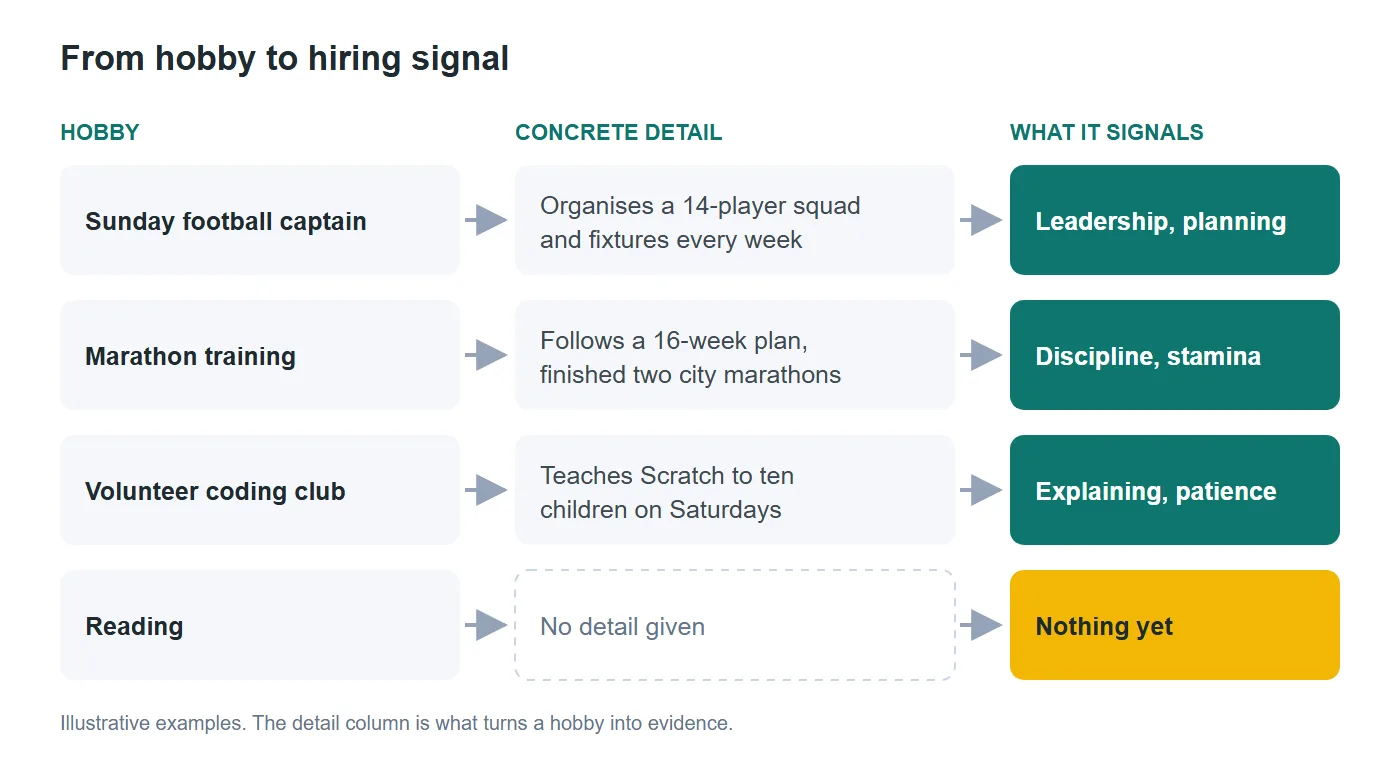
If you are early in your career, lean on this more. Our student resume examples and the resume with no experience guide show how a club role or a long-running project can stand in for a first job. Experienced candidates should usually keep interests to a single line, or drop them.
How to write the interests section on a resume
Once you have chosen what to include, the format is simple. Keep it short, plain and last. Here is the method we use when building a resume from scratch:
- Name the section clearly. "Interests" or "Hobbies and interests" both work. Applicant tracking systems (the software many employers use to read and sort applications) look for familiar section headings, so skip clever titles like "Life outside work".
- Write one line, two at most. Separate items with commas or semicolons, and give each one a detail.
- Lead with the most relevant item. If only one interest connects to the job, put it first, or keep only that one.
- Use plain text. No icons, no skill bars, no picture grid. Greenhouse, a widely used recruiting platform, lists "graphics, photos, or word art" among the causes of an unsuccessful resume parse.
- Be ready to talk about it. If you list it, assume you will be asked about it. Prospects puts it plainly for skills, and the same applies here: you need to back up your claims at interview.
Here is how the same section reads before and after that method.
| Weak version | Strong version |
|---|---|
| Interests: reading, travelling, music, sports, movies, socialising | Interests: captain of a five-a-side football team (organise weekly fixtures for 14 players); teaching myself Spanish, currently at B1 |
| Hobbies: coding, gaming | Interests: built and maintain a free budgeting app with around 200 monthly users; competitive chess, club rating 1650 |
| Hobbies: volunteering | Interests: weekend volunteer at a food bank since 2023, now train new volunteers on stock logging |
The strong versions are illustrative, so replace every number with your own. Never round up a hobby to make it sound grander. A rating, a user count or a race time is the first thing a curious interviewer will check.
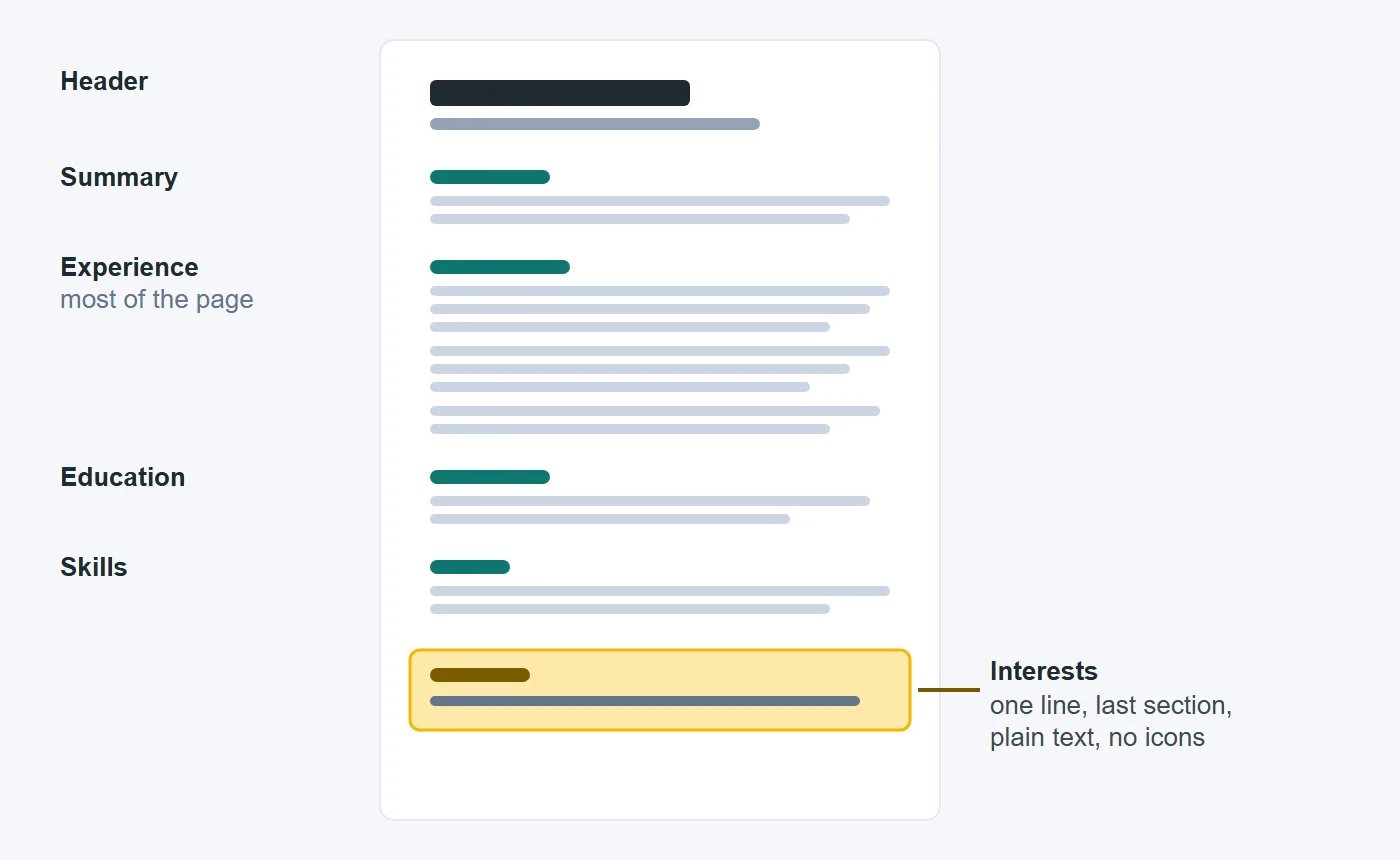
In our free resume builder you can add a custom section and title it "Interests". The PDF keeps it as real, selectable text, so a parser reads it as words rather than as an image. If you would rather start from a layout, browse the resume templates first and add the section only if it passes the test above.
Hobbies on a CV versus a US resume
Expectations for hobbies on a resume shift by country, and the words "resume" and "CV" carry some of that difference. Prospects notes that in countries such as the USA and Canada, CVs are known as resumes, and that US documents tend to be more concise. If you want the full comparison, our guide to the curriculum vitae covers it.
In practice, a hobbies section is a little more common on a UK or European CV than on a one-page US resume. UK guidance from the National Careers Service openly invites interests that show skills. A concise US resume rarely has spare lines, so interests tend to appear only when they connect directly to the job. Either way, the bar is the same: relevance and proof.
One point holds everywhere. Keep hobbies from revealing personal details you would not otherwise share. The National Careers Service says you should not include your age, date of birth, marital status or nationality on a CV. Some hobbies quietly reveal similar things, for example a religious role, a political campaign or a health condition. You are free to include them if they are relevant and you are comfortable, but do it on purpose, not by accident.
If you are writing a European-style document, check our CV format guide for section order, or build it directly in the CV maker, which uses A4 by default.
Hobbies and interests mistakes to avoid
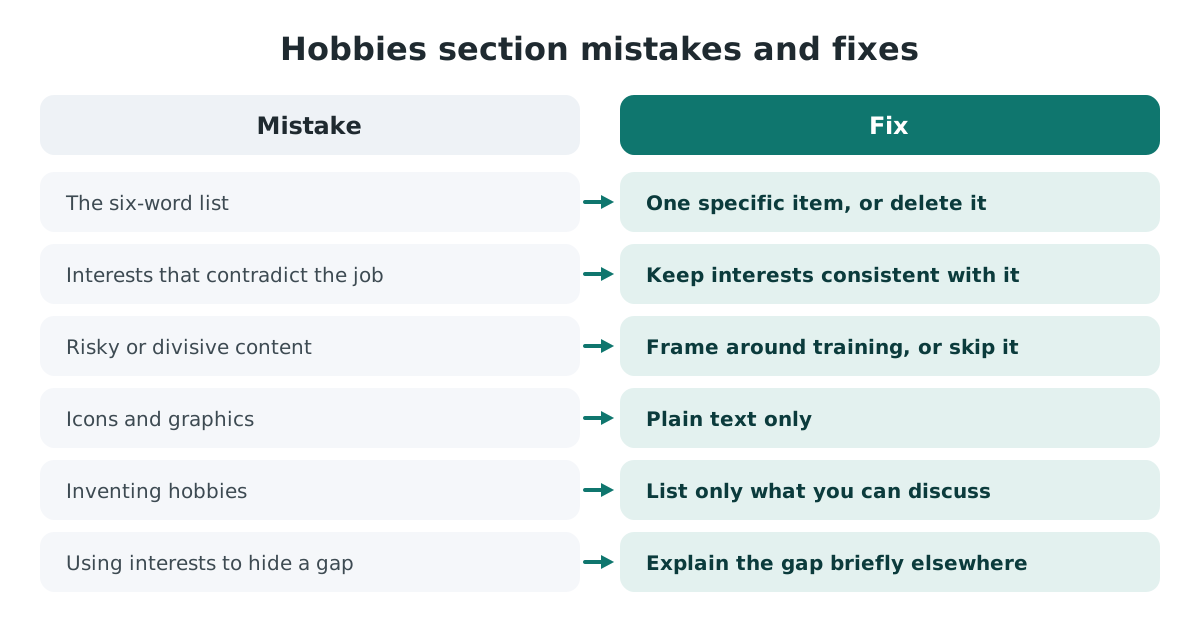
These are the slips that most often turn an interests line from neutral into negative, and every one of them is easy to fix.
- The six-word list. "Reading, music, travel, food, films, friends" tells the reader nothing and costs a whole line. Cut it to one specific item or delete it.
- Interests that contradict the job. Applying for a detail-heavy compliance role while your only interest is "spontaneous travel, no plans" is a small own goal.
- Risky or divisive content. Extreme sports are fine if framed around training and safety. Gambling, partisan politics and anything that needs a disclaimer usually are not worth the risk.
- Icons and graphics. A row of little guitar and plane icons looks friendly but can disappear or garble in parsing, as the Greenhouse list above shows.
- Inventing hobbies. Claiming chess when you barely know the rules works until an interviewer turns out to be a club player.
- Using interests to hide a gap. If you took time off, explain it briefly in your experience or cover letter instead. A short, honest paragraph in a letter from our cover letter generator does that job far better.
Quick rule: if you cannot talk about a hobby for two minutes with enthusiasm and one real example, it does not belong on the page.
A final contrarian note. Some advice says interests "humanise" every resume and should always be there. We think that is backwards. A resume is humanised by clear writing and real results. Interests add colour only when they are specific, so treat them as optional, and you will rarely go wrong.
Final check before you send it
Before you export the document, run through this short checklist for the hobbies on your resume:
- Each interest connects to the job, to a skill in the ad, or to a trait the role needs.
- Each interest carries one concrete detail: a number, a role, a result or a time span.
- The section is one or two lines, sits at the end, and uses a standard heading.
- Everything is plain text, with no icons or graphics.
- Nothing reveals personal details you did not mean to share.
- Your experience and your best results still fit on page one.
Interests sit close to two other sections that deserve the same care. Our guide to resume skills explains how to choose and prove the skills your hobbies point to, the resume font guide keeps the whole page readable, and our note on references on a resume covers the other section people often tack on at the end. For the full structure, start with how to write a resume and check it against the ATS-friendly resume rules.
When the resume is ready, you can build it, download the PDF and pair it with a matching letter in a few minutes. Open the resume builder, no sign-up needed, and your data stays in your browser. And when a new job eventually means leaving the current one, the resignation letter tool will help you do that gracefully too.
Frequently asked questions
Should I put hobbies on my resume?
Only if a hobby connects to the job, proves a skill named in the job ad, or shows a trait the role needs, and only if it fits after your experience. Prospects advises that if you have no relevant hobbies or interests, you should leave the section out.
What are good hobbies to put on a resume?
Good hobbies are specific and come with a detail: captaining a sports team, coding side projects, writing a newsletter, volunteering, tutoring, competitive chess or learning a language. The detail, such as squad size, users or level, is what makes the hobby believable.
Where do hobbies go on a resume?
In a short section titled "Interests" or "Hobbies and interests" at the end of the resume, after experience, education and skills. One line, plain text, no icons.
How many hobbies should I list?
One or two is usually enough. A long list of generic hobbies costs space and tells the reader very little. If only one interest relates to the job, list only that one.
Are hobbies and interests the same thing on a CV?
They are used interchangeably. Hobbies are things you do, such as running or photography, while interests can also include topics you follow, such as sustainable design. Either way, keep them relevant and specific.
Can hobbies hurt my job application?
Yes, if they are generic filler, push important content off page one, reveal personal details you did not mean to share, or invite bias. Research by sociologist Lauren Rivera found that evaluators at elite firms favoured candidates with leisure pursuits similar to their own, so choose and phrase interests deliberately.
Should students include hobbies on a resume?
Students and first-time job seekers benefit most, because a club role, team captaincy or long-running project can show responsibility that paid work has not yet shown. The National Careers Service gives the example of a sports team captain demonstrating leadership and organisation.