
Resume Summary: A Simple Formula and 12 Examples
Show contents
- What a resume summary is, and what it is not
- When a resume summary helps, and when to skip it
- A resume summary formula that works for any job
- 12 resume summary examples by career stage and job
- Tailoring your summary for the job ad, and for ATS
- First person, third person, or neither?
- Resume summary mistakes that make recruiters skip ahead

A resume summary is a two to four sentence paragraph at the top of your resume that states your professional title, your strongest skills and one piece of proof, so a recruiter knows in seconds why you fit the job. The University of Texas at San Antonio career guide describes it as 2 to 4 sentences that show "what you can offer", in contrast to an objective, which states what you want.
Below you will find a five-part formula, 12 resume summary examples you can adapt, a section on tailoring the summary to a job ad, and the mistakes we see most often. If you write CVs for the UK or Europe, the same idea goes by another name; our guide to the CV personal statement covers that version.
What a resume summary is, and what it is not
The summary goes directly under your name and contact details and above your experience. Simmons University's career center calls it "a concise introduction to you" and notes that it is where "you can select the keywords about your background that you want to stress" (Simmons University, Building a summary statement). It may carry a heading such as "Summary", "Professional Summary" or "Summary of Qualifications".
People confuse three short opening sections. Here is how they differ:
| Resume summary | Resume objective | CV personal statement | |
|---|---|---|---|
| Main market | US and Canada | US, mostly entry level | UK, Ireland, Europe |
| Focus | What you offer | What you want | Who you are, what you offer, what you want |
| Best for | Anyone with relevant experience | Very early career or a sharp career change | Most CVs |
| Typical length | 2 to 4 sentences or 3 to 5 bullets | 1 to 2 sentences | A few short lines |
The UTSA guide draws the line in one sentence: "Unlike an objective (what you want), the summary shows what you can offer" (UTSA, Summary statement basics). In our view, that framing is the whole game. Recruiters are reading to answer their question, not yours.
When a resume summary helps, and when to skip it
First reads are short. In a 2018 eye-tracking study by the job site Ladders, recruiters spent an average of 7.4 seconds on an initial resume screen, according to HR Dive's report on the study. The same report says resumes with simple layouts, clear sections and clear headings held attention best. Simmons University makes a similar point, saying you "may only have 5-10 seconds" of a reader's time.
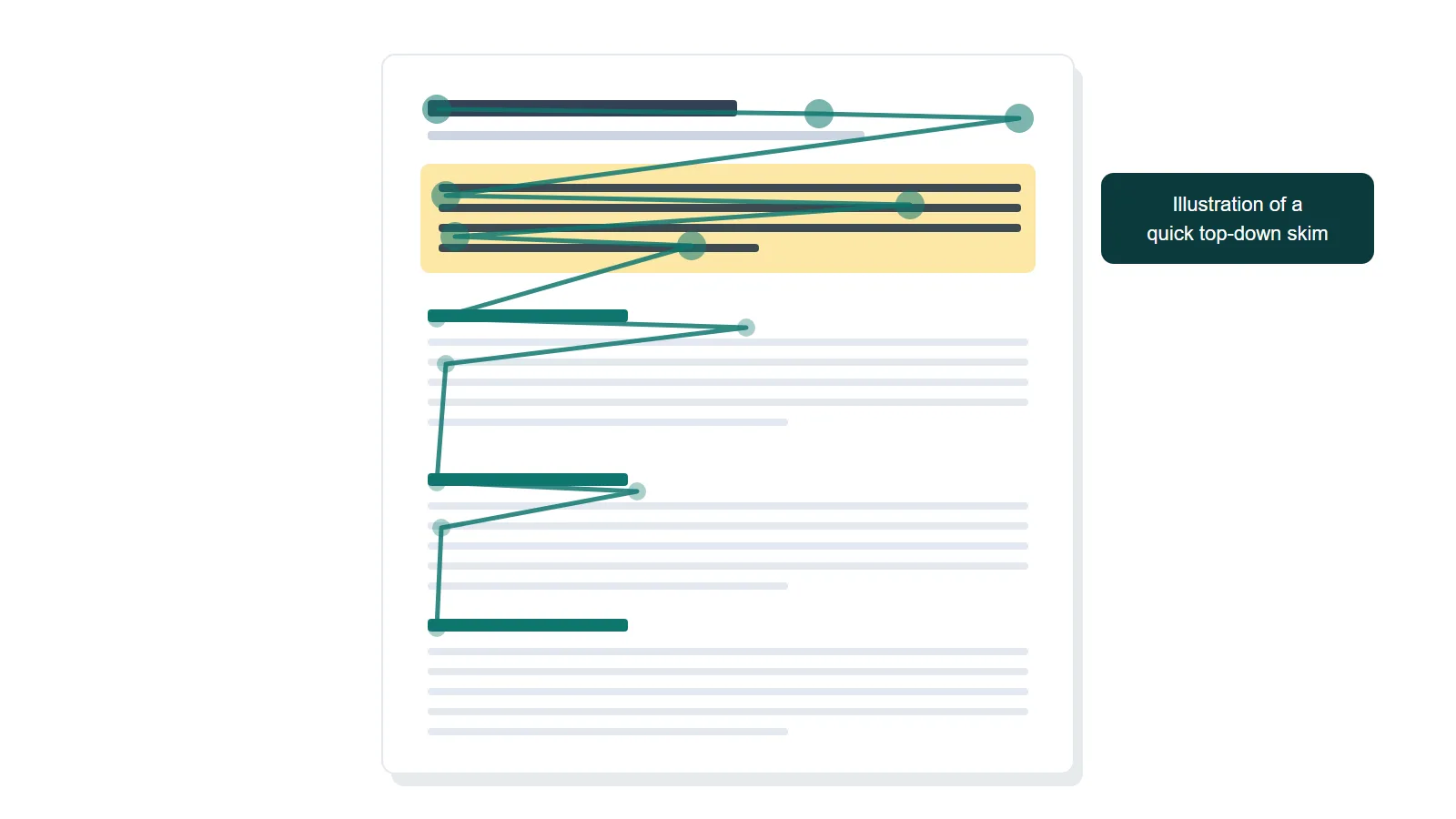
That makes the summary valuable in three situations:
- You have a clear professional identity. A title plus years of experience frames everything below it.
- Your best evidence is not in your latest job. The summary lets you pull a result forward from three years ago.
- You are changing direction. A summary can connect old experience to a new target before the reader sees an unrelated job title.
When can you skip it? On a one-page resume for a student with a strong, directly relevant internship, the space may be better used for one more bullet under experience. Many student layouts go straight from contact details to education, and we think that is a fair choice; see our Harvard-style resume template and student resume examples for that layout. For everyone else, write the summary.
A resume summary formula that works for any job
UTSA offers a fill-in formula: "[Adjective] [role/identity] with [# years/experience] in [skill/field], proven ability to [measurable result], and strong background in [related context]." Clark College says a well-written summary addresses three things: your experience and skills as they relate to the job, what you can bring that other candidates cannot, and your professional goals (Clark College, How to write a winning resume summary statement).
We merged the two into five parts. You do not need all five every time, but you should be able to point to each one if you include it.
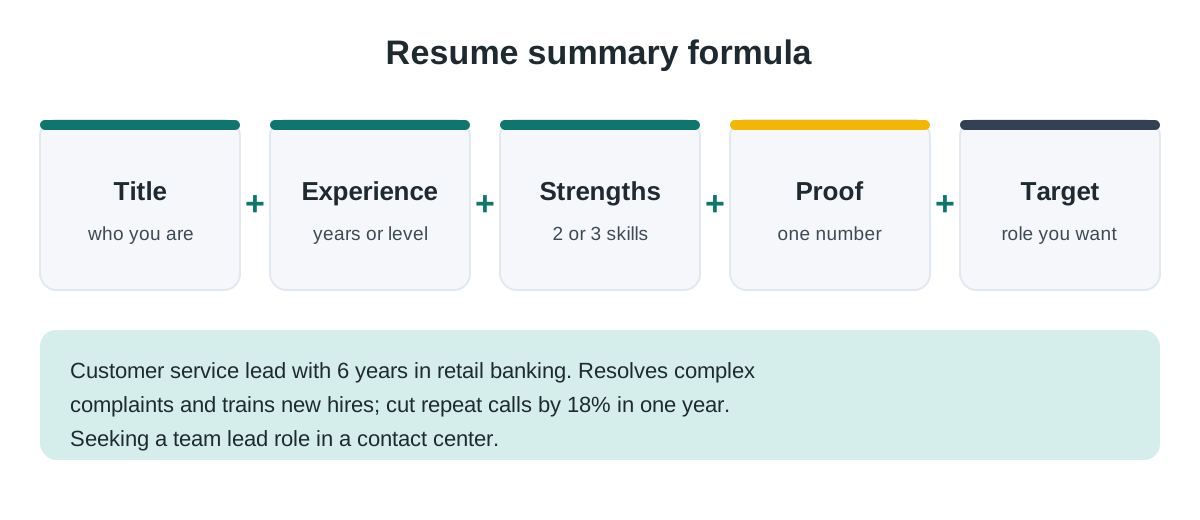
- Title. The job you do, or the one you are qualified for. Match the ad's wording when it is honest to do so.
- Experience. Years, level or scope ("6 years", "team of 12", "multi-site").
- Strengths. Two or three skills from the job ad. UTSA suggests picking two or three key skills that fit you best.
- Proof. One number or concrete result. This is the sentence most people skip and the one that matters most.
- Target. Optional, but useful for career changers: the role you are aiming for.
If you want to see it in place, our free resume builder has a summary field at the top of every template, and the live preview shows how many lines your draft uses.
12 resume summary examples by career stage and job
These resume summary examples are samples we wrote for this guide; the people and numbers are fictional. Each one follows the formula, and each would be rewritten for a specific job ad.
By career stage
Entry level: Business administration graduate with a 6-month internship in accounts payable. Processed 300+ invoices per month in a shared-services team and built a spreadsheet tracker the team still uses. Seeking a junior finance assistant role.
Student, part-time role: Second-year hospitality student with two summers of front-of-house experience in a 90-seat restaurant. Comfortable with POS systems, cash handling and busy weekend shifts. Available 20 hours per week.
No formal experience: Recent high school graduate with a strong attendance record and three years of weekend volunteering at a food bank, including stock rotation and training new volunteers. Looking for a first role in retail or warehouse operations.
Mid-career: Marketing manager with 8 years in B2B software, leading a team of four. Rebuilt the email nurture program and lifted demo requests from organic leads by 25% in a year. Strong in lifecycle marketing, analytics and agency management.
Senior: Operations director with 15 years in regional healthcare, responsible for five clinics and a 210-person staff. Led the consolidation of two scheduling systems with no loss of appointment capacity. Known for steady change management and clear reporting to boards.
Career changer: Former retail store manager moving into HR, with 7 years of hiring, scheduling and coaching hourly teams of up to 40. Completed an HR fundamentals certificate in 2026. Seeking an HR coordinator role where frontline experience is an asset.
By job
IT support: IT support specialist with 4 years supporting 600 users across Windows and macOS. Resolves most tickets at first contact and wrote the knowledge-base articles that cut repeat password tickets. CompTIA A+ certified.
Customer service: Customer service lead with 6 years in retail banking. Resolves complex complaints and trains new hires; cut repeat calls by 18% in one year. Seeking a team lead role in a contact center.
Nurse: Registered nurse with 5 years on a busy medical-surgical unit, experienced in post-operative care, patient education and electronic charting. Precepted 8 new graduate nurses. Seeking a role on a cardiac step-down unit.
Teacher: Elementary teacher with 9 years in grades 3 to 5, specialising in reading intervention. Designed a small-group literacy program used across the grade team. Seeking a reading specialist position.
Data analyst: Data analyst with 3 years in e-commerce, fluent in SQL, Python and dashboard tools. Built the weekly sales dashboard used by 30 managers and automated a reporting task that took 6 hours a week.
Sales: Account executive with 5 years in SaaS sales to mid-market companies. Closed 112% of quota on average over the last three years and shortened the sales cycle by tightening discovery calls.
Notice the pattern: no sample says "hardworking" or "team player", and each one has at least one number. For full documents built around these summaries, browse our resume examples, including resumes with no experience and first job resumes.
Tailoring your summary for the job ad, and for ATS
UTSA's first writing tip is to "Read the job posting and highlight repeated skills or requirements." That is the most useful sentence in this whole guide. The job ad tells you which words the employer cares about, and the summary is where you prove you have them.
A practical routine for each application:
- Copy the job ad into a note and highlight any skill or tool that appears twice or more.
- Check that your title in the summary matches the ad, or explain the gap ("Office manager moving into project coordination").
- Swap one strength in your summary for the most repeated requirement you genuinely have.
- Keep the proof sentence. It rarely needs to change.
On the technical side, keep the summary as plain text in the main body of the page. Applicant tracking systems (ATS, the software employers use to collect and sort applications) need to read it as text. Greenhouse lists "Complex resumes with tables, headers, and footers" and "Resumes that include graphics, photos, or word art" among the causes of a failed parse (Greenhouse support). A summary inside a text box or a page header can disappear in that process.
Our ATS-friendly resume guide covers the full checklist. Every free layout in our resume templates exports the summary as real, selectable text.
First person, third person, or neither?
Advice genuinely disagrees here. Harvard's career office tells you not to "Use personal pronouns (such as I or We)" or "a narrative style" on a resume (Harvard FAS, Create a strong resume). Clark College goes further and says a summary "should be composed in third person, in present tense", like a description a respected colleague might write.
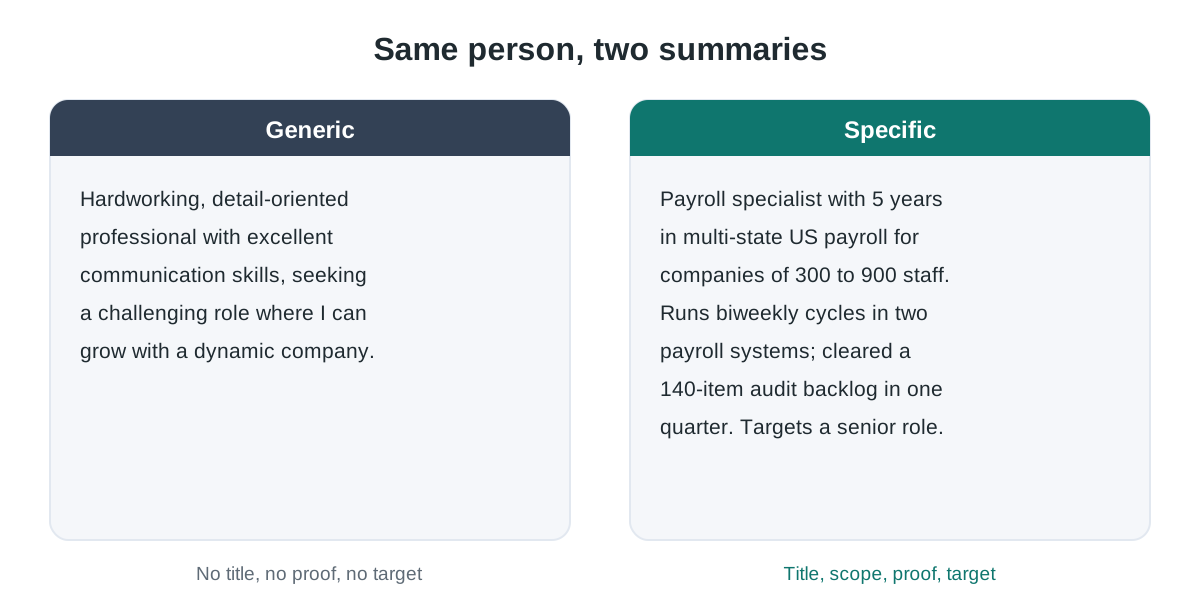
We recommend a middle path that satisfies both: the implied first person. Drop the pronoun and start with the title. "Payroll specialist with 5 years..." reads cleanly, avoids "I", and does not sound like you are writing about yourself as a stranger. Full third person ("Jane is a payroll specialist...") feels odd on a document with your own name at the top, and we would avoid it.
The same rule covers UK CVs. Prospects describes the CV profile as "a concise statement that highlights your key attributes" (Prospects, How to write a CV), and the implied first person reads naturally there too.
Resume summary mistakes that make recruiters skip ahead
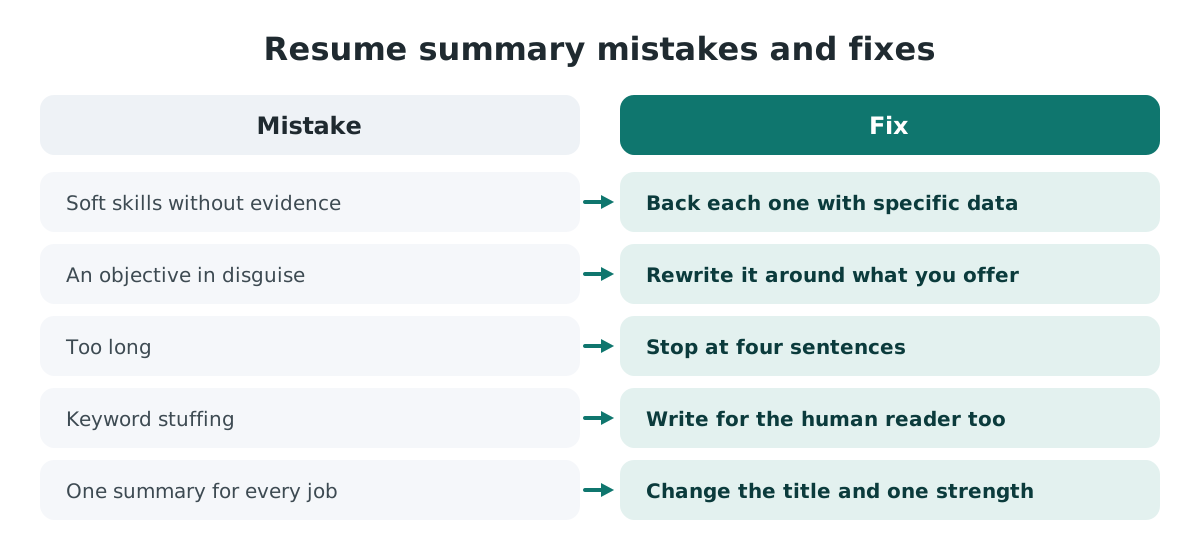
- Soft skills without evidence. Clark College warns against soft skills "unless they are backed up by specific data". "Personable" means nothing; "kept a 96% customer satisfaction score" means something.
- An objective in disguise. Clark's own example of what to avoid is "Currently seeking position in which to grow with dynamic organization." If your summary is about what you want, rewrite it around what you offer.
- Too long. Past four sentences, a summary starts to compete with your experience section instead of framing it.
- Keyword stuffing. Repeating every term from the ad makes the summary unreadable for the human who reads it after the software.
- One summary for every job. The title and one strength should change per application.
Here is our contrarian point. Many guides push you to sound impressive. We think specific beats impressive every time. "Cleared a 140-item audit backlog in one quarter" is not glamorous, but it is believable, and believable is what gets you an interview.
When your summary is done, the rest of the application goes faster. Build the full document in the resume builder (or the CV maker for A4 markets), write a matching letter with the cover letter generator, and prepare the last page with our guide to references on a resume. For a refresher on the terms, read resume vs CV, and for the full process, our guide on how to write a resume.
Frequently asked questions
How long should a resume summary be?
Two to four sentences, or three to five short bullet points. The UTSA career guide recommends 2 to 4 sentences. Longer than that and it starts to repeat your experience section.
What is the difference between a resume summary and an objective?
A summary describes what you offer: your title, skills and proof. An objective describes what you want. University guides such as the UTSA one draw exactly that line. We recommend a summary for anyone with relevant experience, and an objective only for the very start of a career.
Should a resume summary be written in first person?
Use an implied first person: drop "I" and start with your title, as in "Data analyst with 3 years...". Harvard advises against personal pronouns on resumes, and this style avoids them without sounding like third-person narration.
Do I need a resume summary if I am a student?
It is optional. A short summary helps if you want to frame part-time work or projects for a specific job. If your one-page resume is already full of directly relevant experience, you can skip it.
Can I use bullet points in a resume summary?
Yes. Simmons University shows both a paragraph "Summary" and a bulleted "Summary of Qualifications" format. Use bullets if your strengths are distinct items, and a paragraph if they tell one story.
What should I put in a resume summary with no experience?
Lead with your qualification or study level, add one piece of evidence from school, volunteering or a project, list two skills from the job ad, and name the role you want.
Is a resume summary the same as a CV personal statement?
They do the same job. "Resume summary" is the US term; "personal statement" or "personal profile" is common in the UK. A CV statement often adds a sentence on the role you want.
Sources
- UTSA Carlos Alvarez College of Business: Summary statement basics
- Clark College Career Services: How to write a winning resume summary statement
- Simmons University Career Education Center: Building a summary statement
- Harvard FAS Mignone Center for Career Success: Create a strong resume
- HR Dive: Eye-tracking study shows recruiters look at resumes for 7 seconds (2018)
- Prospects: How to write a CV
- Greenhouse Support: Unsuccessful resume parse