
References on a Resume: Should You Include Them, and How?
Show contents
- Should you put references on a resume? The short answer
- Resume references in the US vs CV references in the UK
- Who to ask: professional and character references
- How to put references on a resume page: format and example
- Is "references available upon request" still worth writing?
- How to ask someone to be your reference
- Reference mistakes that cost interviews

Should you put references on resume documents? In most cases, no. US and UK career services agree that references belong on a separate reference page, not on the resume itself, and that you send that page only when an employer asks for it. Harvard's career office puts "List references" on its list of resume don'ts, and the UK National Careers Service says "you should not put someone else's contact details on your CV".
That does not mean references stop mattering. They usually come in late, after an interview, when a hiring manager wants to confirm what you told them. This guide explains when to include references, who to ask, how to format each entry, and what to write instead on the resume.
Should you put references on a resume? The short answer
For most applications, the best place for references on a resume is nowhere: leave them off and keep a ready-made reference sheet instead. Here is what the guides we checked say, in their own words:
- Harvard's Mignone Center for Career Success lists "List references" among the things not to do on a resume (Harvard FAS, Create a strong resume).
- Kutztown University's career center is even more direct: "Do not include references in your resume, always a separate page." It adds that you "likely will not submit your references list with the resume and cover letter, but should be prepared to send one in upon the employer's request" (Kutztown University, Sample reference sheet).
- Coppin State University's guide says references "should ALWAYS be on a separate document from your resume", and should be included "when an advertisement specifically calls for them" (Coppin State University, References).
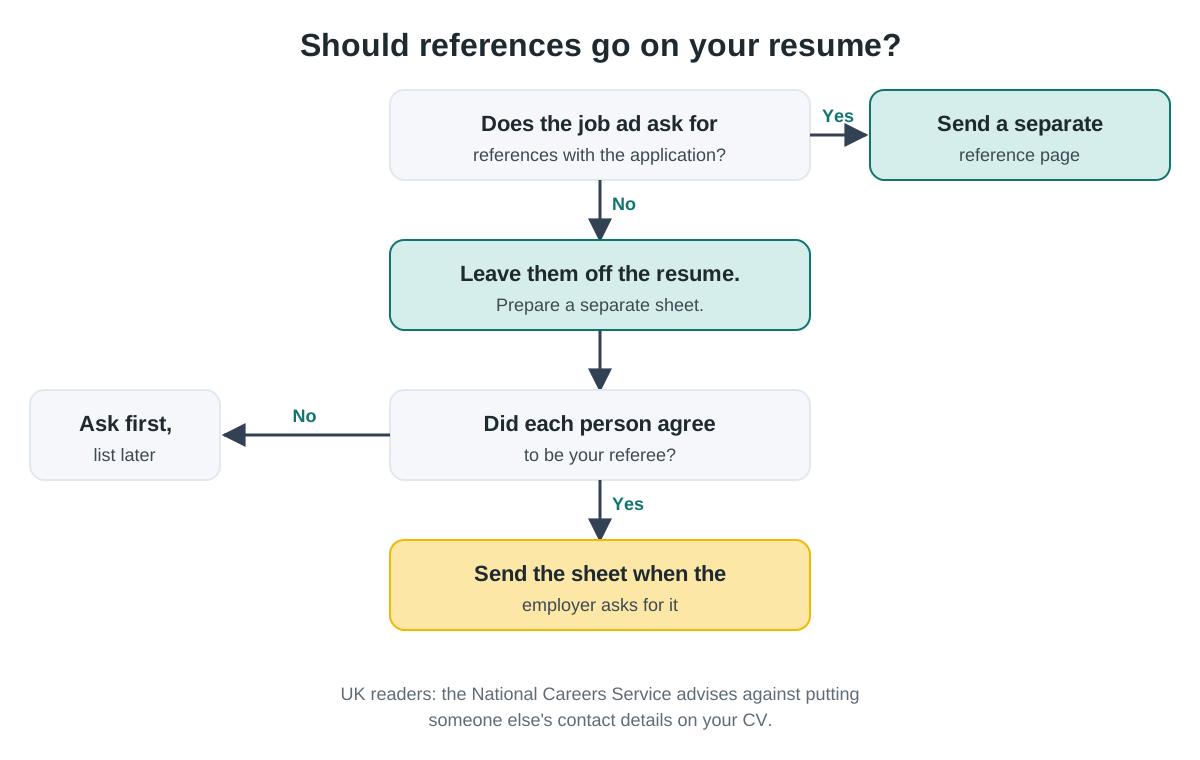
Why the consensus? Space is one reason: a resume has to fit a lot into one or two pages, and four names with phone numbers take room that your experience could use. Privacy is another. A resume gets uploaded to job boards and forwarded between people, and your former manager did not agree to have their mobile number travel with it.
Resume references in the US vs CV references in the UK
The advice is similar on both sides of the Atlantic, but the details differ, which is why searches like "cv references" and "resume references" give slightly different answers.
| US resume | UK CV | |
|---|---|---|
| On the main document? | No. Harvard lists it as a don't. | Optional short section, but no third-party contact details |
| What to write instead | Nothing; prepare a separate sheet | "References available on request" or the referee's name and job title only |
| How many | 3 to 5 is the common range (Coppin State) | "Two or more" people (nidirect) |
The UK guidance has a nuance worth knowing. The National Careers Service says "You might want to include a section about references if there is someone who has agreed to give you one", and that referees could be "your current or previous employer, a teacher or someone respected in your community", but also that "you should not put someone else's contact details on your CV" (National Careers Service, CV sections). So a UK CV can name a referee, without the phone number and email.
Prospects adds that "You don't need to provide the names of referees at this stage" (Prospects, How to write a CV), and nidirect notes that "You don't have to include references in your CV" while recommending that you line up "two or more people who can provide a work or personal reference" (nidirect, CVs and cover letters). If you are not sure which document your market expects, our explainer on resume vs CV covers the naming and the CV format guide covers layout.
Who to ask: professional and character references
A reference is only as useful as what the person can actually say about your work. UNC Chapel Hill's career office puts it well: "The best references come from individuals who have had the opportunity to objectively observe your skills and abilities, such as professors, advisors, and past or current supervisors." The same page says "Coworkers, peers, and family members are not recommended for use as references" (UNC Chapel Hill University Career Services).
Coppin State's list of people to consider includes former or current supervisors, professors, academic advisors, mentors, customers or clients, colleagues, coaches and contacts from volunteer work, and it advises: "Do not use personal references (friends, family)."
What about a character reference?
A character reference speaks to who you are rather than how you performed in a specific job: a volunteer coordinator, a sports coach, a teacher who knew you well. UK guidance explicitly allows "someone respected in your community", and nidirect mentions "a work or personal reference". A character reference on a resume works best when you have little formal work history, such as a first job or a return to work. Pair it with at least one professional reference when you can.
Our suggestion for a balanced list of three: your most recent manager, one earlier manager or a professor, and one person who saw a different side of you (a client, a coach or a volunteer lead). Notice that "most recent manager" can be awkward if you have not told your employer you are leaving. In that case, say so to the recruiter and offer a previous manager first.
How to put references on a resume page: format and example
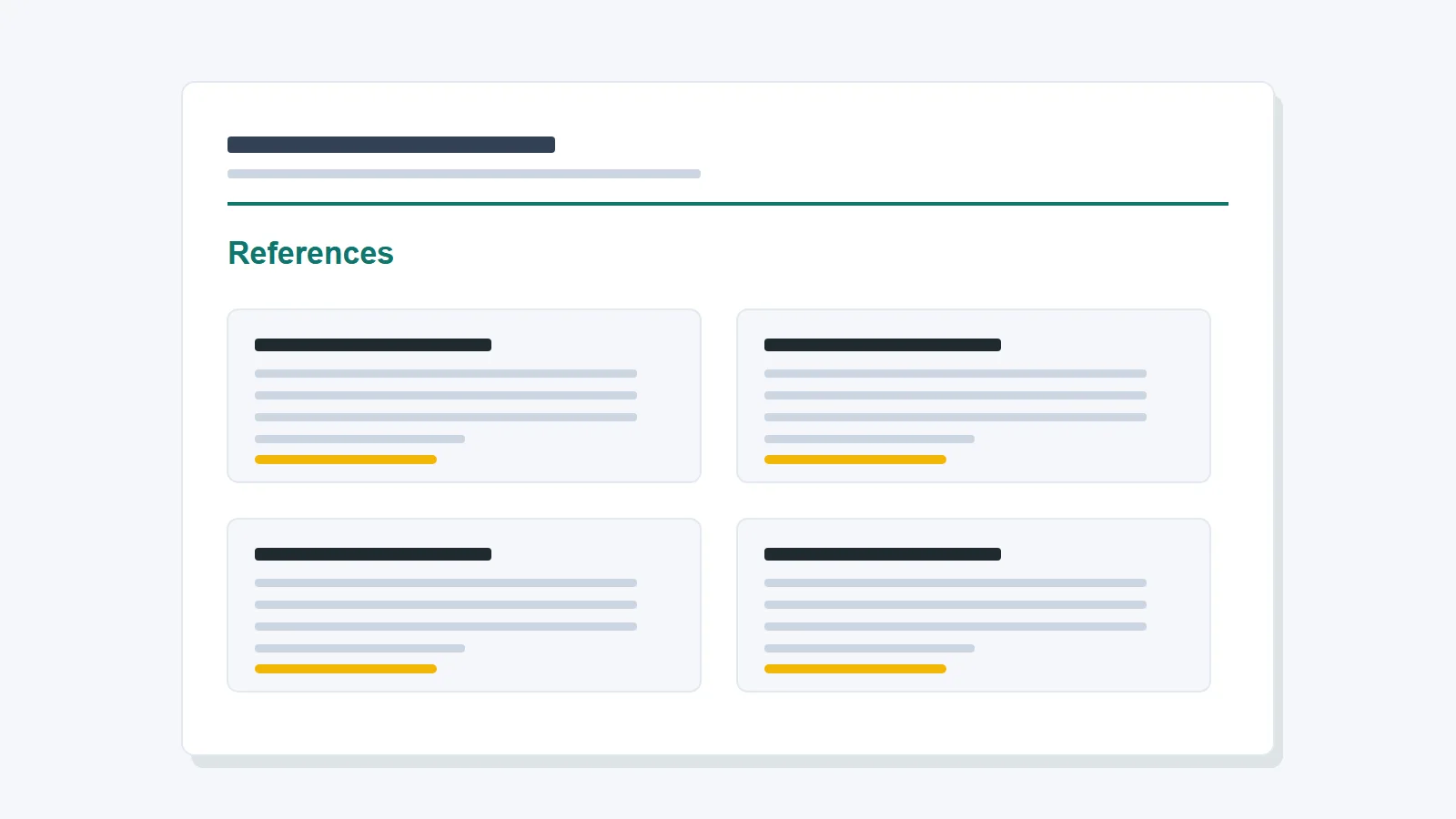
"Putting references on a resume" today almost always means building a matching reference page. Kutztown, Coppin State and many other US career centers publish sample sheets, and they share the same structure.
- Same header as your resume. Coppin State says to "Include your name and contact information as it appears on your resume", so the sheet is obviously part of the same application.
- A clear title. "References" is enough.
- Three to five entries. Coppin State recommends "3-5 professional references".
- The same fields for every entry. Name with courtesy title, position title, company or organisation, mailing address, telephone number and email address, per Coppin State's list. Most people now leave out the mailing address.
- One line on the relationship. Not in every sample, but we think it saves the recruiter a question.
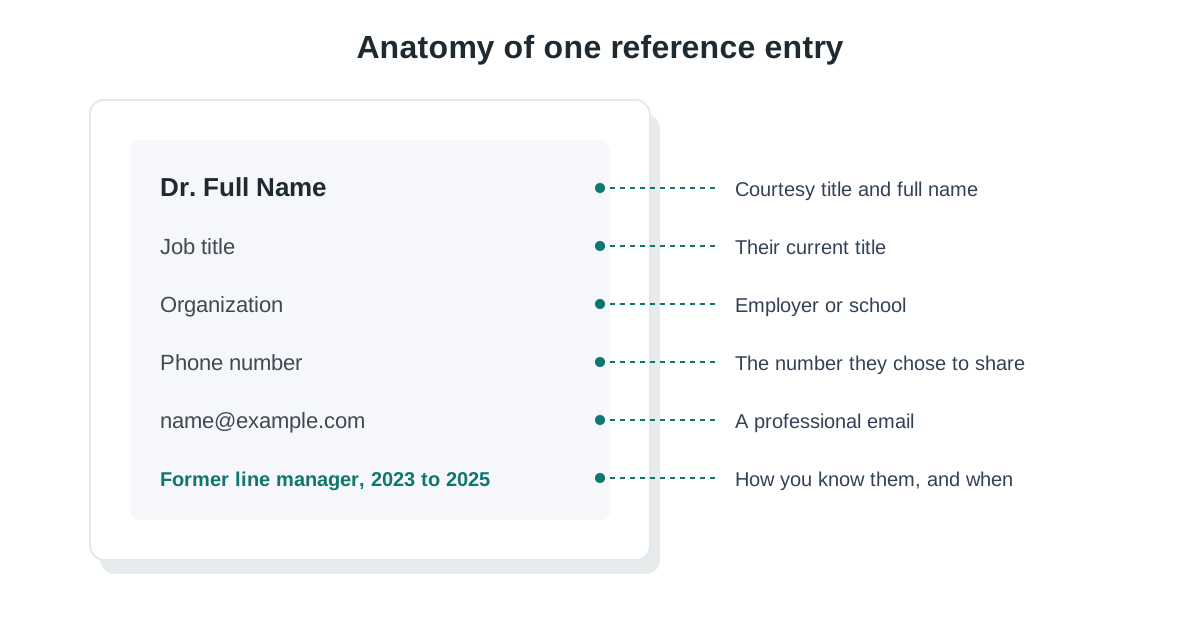
Here is what one entry looks like in plain text. The person is fictional, and the phone number and domain are placeholders:
Ms. Dana Whitfield
Head of Customer Operations
Northfield Home Insurance
(555) 010-2244
dana.whitfield@example.com
Former line manager, 2022 to 2025
Build the sheet in the same tool and font as your resume. In our free resume builder you can duplicate a document, delete the sections you do not need and keep only the header, which gives you a matching reference page in a couple of minutes. The resume templates and the classic Harvard-style resume template both work well for this. Keep the file as text, not a scanned image: applicant tracking systems such as Greenhouse report parse failures on "Resumes that are uploaded as an image, rather than a document" (Greenhouse support).
Is "references available upon request" still worth writing?
When it comes to references on a resume, most US advice now says no to this line, and some UK advice still says yes, so here is the honest version. Prospects notes that you can write "references available upon request", but that employers would usually assume this anyway, and that you can leave the section out if space is tight. The National Careers Service, on the other hand, offers it as the alternative to listing referees.
We side with leaving it out on a US resume and keeping it optional on a UK CV. The line tells the reader nothing they do not already expect, and it uses a line you could spend on a result. The exception is a UK CV that looks short or unfinished without a closing section, such as a school leaver's first CV, where the line signals that you have thought about it.
How to ask someone to be your reference
Every guide we read agrees on one rule. UNC says "Ask for permission before listing someone as a reference", Kutztown says "Be sure to ask permission before including anyone as a reference!", and Coppin State adds: "Always ask a reference what information can be included on your reference page."
A good request does three things: it asks clearly, it makes saying no easy, and it gives the person what they need to say something specific. Send your current resume and a short note on the roles you are applying for, as UNC and Coppin State both recommend. Here is a short email you can adapt:
Hi Dana, I hope you are well. I am applying for customer operations manager roles and would love to list you as a reference, since you saw my work on the claims backlog project first-hand. Would you be comfortable with that? If yes, could you tell me which phone number and email you would like me to share? I have attached my current resume. No problem at all if the timing is not right.
After an interview, send a quick heads-up to each referee with the company name and the role, so a call does not come out of nowhere. Kutztown also suggests thanking references when you are hired, "even if you know they were never contacted". If someone writes you a formal letter rather than taking a call, our guides to the reference letter and the letter of recommendation show what a good one includes, which helps if they ask you to draft it.
One more practical point: the way you leave a job shapes the references you get from it. A clear, polite notice written with our resignation letter tool costs nothing and keeps that manager on your list.
Reference mistakes that cost interviews
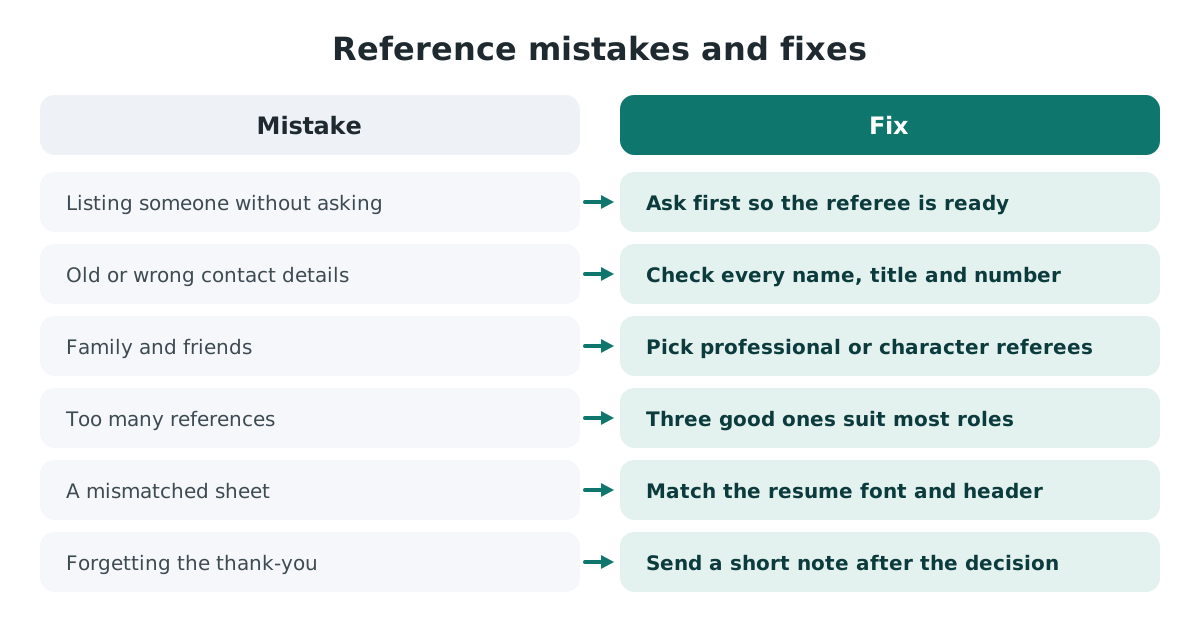
Most problems with references on a resume come from rushing the last step of an application. These are the ones we would check for first.
- Listing someone without asking. A surprised referee gives a cautious, short answer, and that can read as a warning.
- Old or wrong contact details. Check every name, title and number before you send the sheet.
- Family and friends. UNC and Coppin State both advise against them, and recruiters discount them.
- Too many references. Ten names suggest you could not choose. Three good ones are enough for most roles.
- A mismatched sheet. A different font or header makes the page look like an afterthought. Match the resume exactly.
- Forgetting the thank-you. A short note after the decision keeps the relationship warm for next time. Our thank-you email after an interview templates adapt easily for referees too.
Once the reference sheet is ready, the rest of the package is quick. Use the cover letter generator for the letter, read our guide on how to write a resume for the main document, and check the opening paragraph with our guides to the resume summary and the CV personal statement. If this is your first application, the first job resume examples show where a character reference can help most.
Frequently asked questions
Should references be on a resume?
Usually not. Most US and UK career services advise keeping references on a separate page and sending it when the employer asks. Harvard lists "List references" as a resume don't, and the UK National Careers Service advises against putting other people's contact details on a CV.
How many references should I have?
Three is enough for most roles. Coppin State University suggests 3 to 5 professional references, and nidirect in the UK recommends having two or more people ready.
What should a reference entry include?
The person's name with a courtesy title, their job title, organisation, phone number and email address, plus a short line on how they know you. Ask each person which contact details they are happy to share.
Can I use a character reference on my resume?
Yes, especially if you have little work history. A teacher, coach, volunteer coordinator or someone respected in your community can act as a character reference. Add at least one professional reference when you can.
Should I write "references available upon request"?
On a US resume, it is generally unnecessary because employers assume it. On a UK CV it is optional; the National Careers Service offers it as an alternative to listing names, while Prospects notes you can leave it out if space is tight.
Can I list my current manager as a reference?
Only if they know you are looking. If they do not, tell the recruiter, offer a previous manager first, and ask that your current manager be contacted only once you have an offer.
Do I need to ask permission before listing a reference?
Yes. Every career service guide we checked says to ask first. Send your resume and the type of role you are applying for, so your reference can speak to the right skills.
Sources
- Harvard FAS Mignone Center for Career Success: Create a strong resume
- National Careers Service (GOV.UK): How to write a CV, CV sections
- Prospects: How to write a CV
- nidirect (Northern Ireland government): CVs and cover letters
- Kutztown University Career Development Center: Sample reference sheet
- Coppin State University Career Services Center: References
- UNC Chapel Hill University Career Services: References
- Greenhouse Support: Unsuccessful resume parse