Resume vs CV: The Real Difference and Which One to Send
Show contents
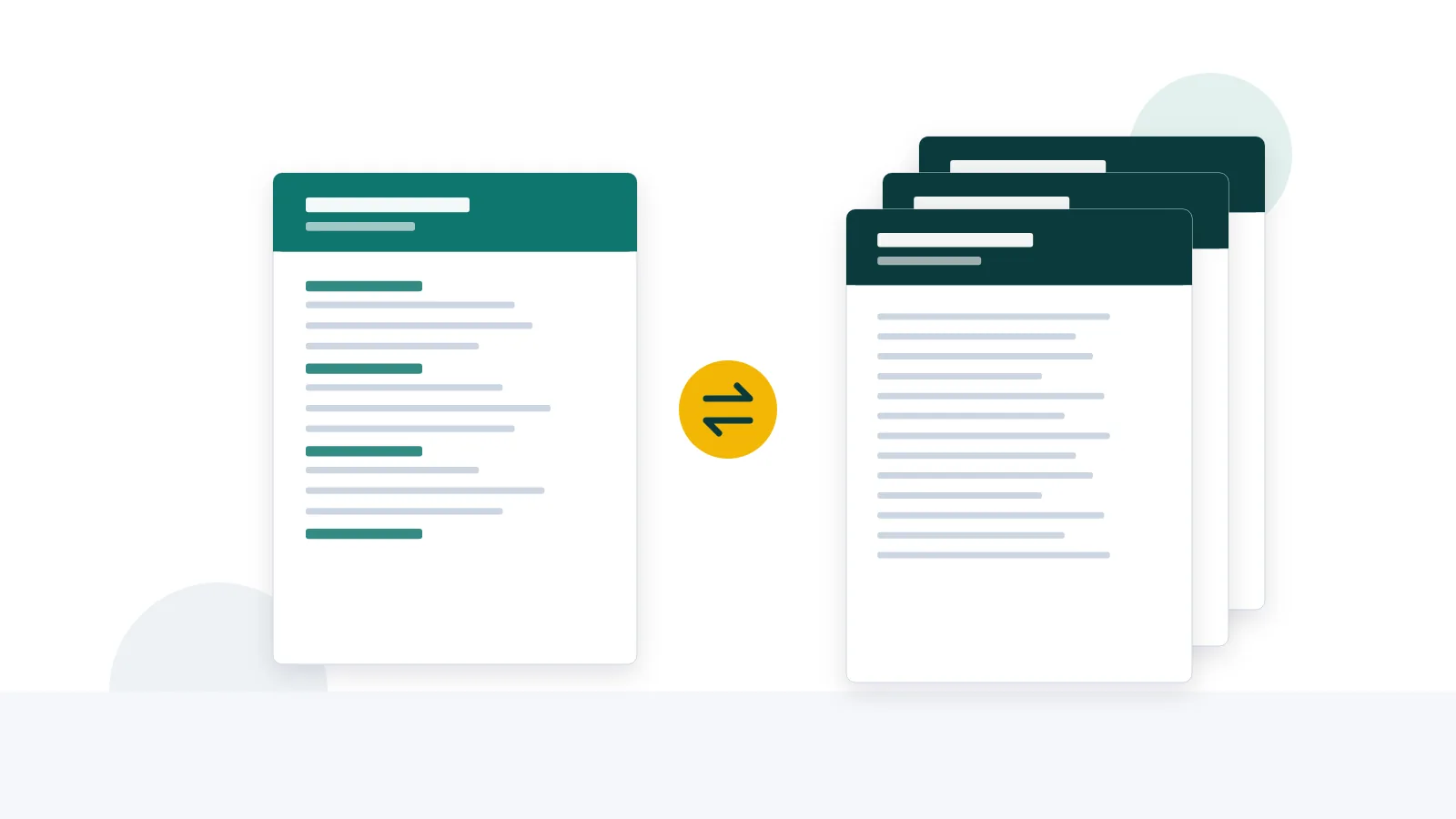
The resume vs CV question has two honest answers, and which one applies depends on where you are applying. In the United States and Canada, a resume is a short, targeted summary of your work history, while a CV (curriculum vitae) is a long academic record of everything you have taught, researched and published. In the UK, Ireland, most of Europe, Asia, Africa and the Middle East, "CV" is simply the everyday word for the document Americans call a resume.
So before you rename a file or pad a page, figure out which of the two meanings your employer has in mind. This guide shows you how to tell, compares both documents side by side, and explains how to turn one into the other without starting from zero.
Resume vs CV: the short answer
If you remember one thing, make it this: the difference between a CV and a resume is mostly about purpose, and only secondly about length. A resume sells you for one specific job. An academic CV documents a whole scholarly career.
The Purdue Online Writing Lab puts it neatly. It says the goal of a resume is "to construct a professional identity", while the goal of a CV is "quite specifically to construct a scholarly identity". The same Purdue OWL guide to writing a CV adds that in the United States, the CV "is used almost exclusively when one is pursuing an academic job".
Outside North America the labels shift. The UK careers service Prospects explains that "in other countries, such as the USA and Canada, CVs are known as résumés", which tells you that a British CV and an American resume are close cousins (Prospects, How to write a CV). Cambridge Dictionary marks the job-hunting sense of "résumé" as US English and gives "CV" as the UK equivalent (Cambridge Dictionary).
Our take: most people searching "cv vs resume" do not need an academic CV at all. They need a one or two page document and the right name for it. Only switch to a long CV when the job is in academia, research, or a field that asks for a publication list.
That is also why we built our free resume builder and our CV maker on the same engine. The content is the same; the conventions around it (page size, length, section names) change with the market.
The difference between a CV and a resume, side by side
Here is how the resume vs CV comparison looks once you add the third document people mix up. "UK-style CV" means the everyday job-hunting CV used in the UK and most of the world. "Academic CV" means the North American scholarly record that Purdue describes.
| US/Canada resume | UK-style CV | Academic CV | |
|---|---|---|---|
| Main purpose | Win one specific job | Win one specific job | Show a full scholarly record |
| Typical length | One page early on; MIT suggests one page "unless you have extensive experience or an advanced degree" | Prospects quotes a recommendation of "no longer than two A4 pages" | Purdue: "often run to three or more pages" |
| Tailored per application? | Yes, heavily | Yes | Lightly; mostly complete |
| Opening section | Summary or objective (optional) | Personal profile | Education first, usually |
| Publications and conferences | Rarely | Only if relevant | Yes, often several sections |
| Default paper size | US Letter | A4 | Letter in the US, A4 elsewhere |
| Photo, age, marital status | Leave out | Leave out | Leave out |
Two rows in that resume vs CV table surprise people. First, the UK-style CV and the US resume do the same job; the only real gaps are spelling, paper size and the name of the opening section. Second, personal details are out on both sides of the Atlantic. Harvard's career office lists "Include a picture" and "Include age or gender" under its "Don't" column (Harvard FAS Mignone Center), and the UK National Careers Service says "you should not include your age, your date of birth, whether you're married or your nationality" (National Careers Service).
Which countries say CV and which say resume
The word itself is the biggest source of confusion in the curriculum vitae vs resume debate. "Résumé" comes from the French résumer, "to summarize" (Wikipedia, Résumé), and North America adopted it for the short job document. Much of the rest of the English-speaking world kept the Latin "curriculum vitae", roughly "the course of one's life", for the same short document.
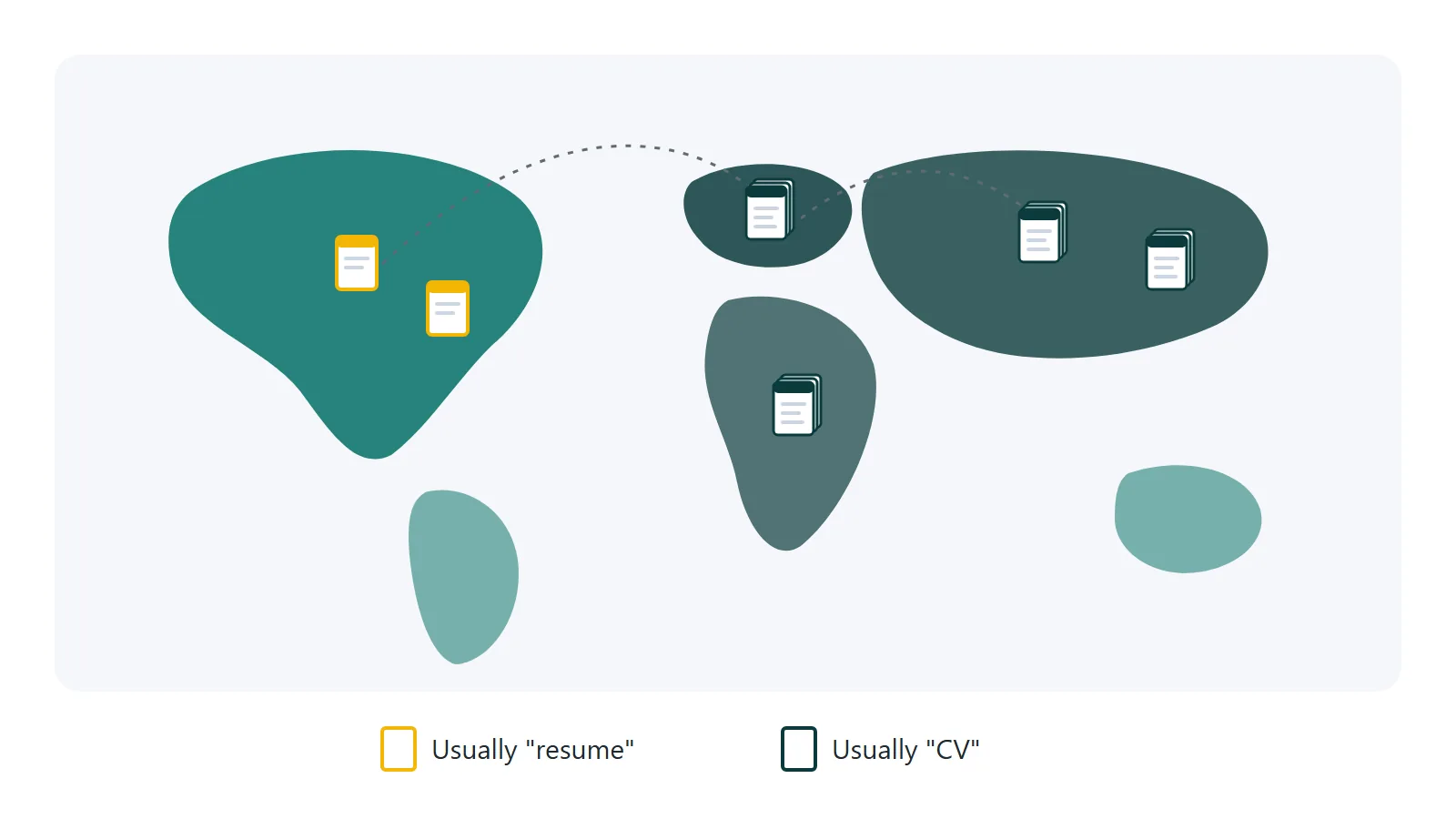
Wikipedia's summary of usage is that "in the EMEA and Asian countries, a curriculum vitae (CV) is used for similar purposes" as the American resume. In practice you will meet a few patterns:
- United States and Canada: resume for almost every job; CV only for academic, research and some medical roles.
- UK and Ireland: CV for almost every job. Northern Ireland's official guidance suggests you "aim for no more than two pages" (nidirect).
- European Union: CV, often in the Europass format. The European Commission offers it free "in 31 different languages" (Europass).
- India, the Gulf, Southeast Asia and Africa: job ads use both words, often for the same short document, so read the ad for length hints. Some employers also ask for a "biodata".
- Australia and New Zealand: you will see both words in job ads; treat them as the short document unless the role is academic.
Paper size follows the same split, and it is the detail most people miss. Unicode's CLDR locale data (the standard that browsers and operating systems use) lists US Letter as the default in the United States, Canada, Mexico, the Philippines and several Latin American countries, and A4 everywhere else (Unicode CLDR supplemental data). A resume printed on Letter in London looks slightly odd; a CV printed on A4 in Chicago gets cropped on some printers. Our tools default to Letter in resume mode and A4 in CV mode, and you can switch at any time.
When you really need a full academic CV
The long CV is a specialist document, and it deserves its own rules. Purdue calls it "an overview of your life's accomplishments, most specifically those that are relevant to the academic realm". Unlike a resume, it does not try to be short. It tries to be complete and easy to verify.
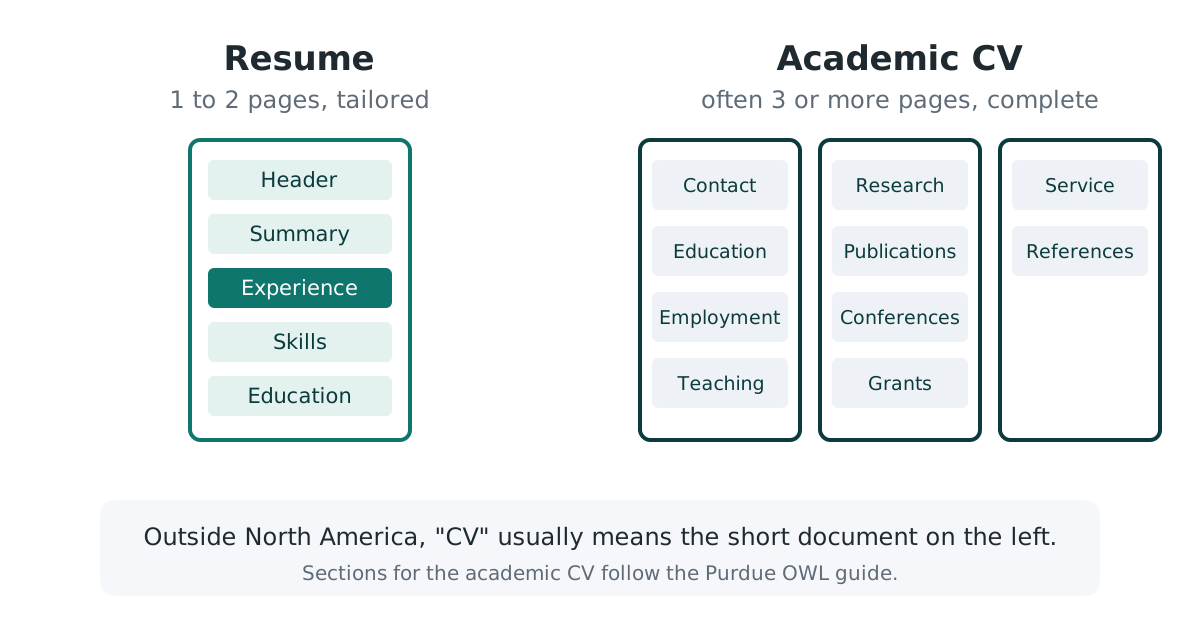
Purdue lists the sections a CV usually holds:
- Name and contact information
- Education, usually in reverse chronological order
- Academic and related employment, such as teaching, editorial or administrative work
- Research projects, conference papers and publications
- Departmental and community service
- References, either on the CV or on a separate page
You need this version when you apply for faculty posts, postdoctoral positions, research grants, fellowships, PhD programs, or some clinical and scientific roles. You also need it when an employer explicitly asks for a "full CV" or a "CV with publications".
Here is a nuance that most "difference between cv and resume" articles skip: even an academic CV is read quickly. Hiring committees still skim. So keep the most important section near the top, use consistent date formats, and do not bury your best paper on page four. Long is acceptable; disorganized is not. If you are writing your first one, our pillar guide to the curriculum vitae walks through every section, and the CV format guide shows how to lay it out.
How to choose: a four-question test
When a job ad is vague, run through these questions in order. The first "yes" decides it.
- Is the role academic or research based? If you are applying to a university faculty post, a research institute or a grant, send an academic CV.
- Does the ad ask for publications, teaching or a full history? Then it wants the long version, whatever word it uses.
- Is the employer in the US or Canada? Send a resume, even if the ad says "CV". Many North American recruiters use the words loosely, but they still expect one or two pages.
- Is the employer anywhere else? Send a UK-style CV: one or two pages, A4, a short personal profile at the top.
The test sounds simple, but it fixes the most common failure we see: people sending a padded three page document to a US startup because they read that a "CV is longer". In the resume vs CV choice, length is a consequence of purpose, never a goal in itself.
Not sure what the finished document should look like? Browse our resume examples and CV examples for the same jobs written both ways.
Turning a resume into a CV, and a CV into a resume
Once you have settled resume vs CV for a given application, you rarely need to start from a blank page. The two documents share their core: contact details, work history, education and skills. Converting is mostly about adding or cutting.
From resume to academic CV
- Move education to the top and add thesis titles, advisors and honors.
- Add sections for publications, presentations, teaching, grants and service.
- Use full citations in one consistent style.
- Drop the summary or objective; academic readers go straight to the record. (A UK-style CV is different: it usually opens with a short personal statement.)
From long CV to resume
- Pick the five or six achievements that match the job ad, and cut the rest.
- Replace publication lists with one line, for example "Author of 6 peer-reviewed articles on water policy".
- Translate academic language into outcomes: a "research assistantship" becomes "analyzed 3 years of survey data in R".
- Add a two line summary aimed at the role. Our guide to the resume objective explains when an objective beats a summary.
The technical side matters too. Applicant tracking systems (ATS, the software that reads and stores applications) can struggle with complex layouts. Greenhouse, a widely used ATS, lists "complex resumes with tables, headers, and footers" and "resumes that include graphics, photos, or word art" among the causes of failed parsing (Greenhouse support). That applies equally to resumes and CVs, so keep both in a clean single column. Our guide to an ATS-friendly resume covers the details.
Mistakes we see in both documents
Whichever document you send, these errors cost interviews more often than the resume vs CV label ever does.
- Adding a photo or date of birth out of habit. Both Harvard and the UK National Careers Service advise against it for standard applications.
- Listing duties instead of results. "Responsible for social media" says less than "grew newsletter sign-ups from 400 to 1,900 in a year".
- Using the wrong paper size. Check Letter vs A4 before you export.
- Calling it the wrong thing in the file name. Use the word the employer used: "Jane-Doe-CV.pdf" for a UK ad, "Jane-Doe-Resume.pdf" for a US one.
- Sending the same document everywhere. Harvard's advice is to "tailor your resume to the type of position you're seeking", and the same applies to a CV.
One more, and it is our slightly contrarian view: do not obsess over the name. Recruiters rarely reject a strong one page document because you called it a CV instead of a resume. They reject documents that are too long for the market, hard to scan, or not matched to the role. Get those right first.
When you are ready, you can start with our resume templates or CV templates, add a matching letter with the cover letter generator, and download a text-based PDF for free, with no sign-up. If you are leaving a job at the same time, the resignation letter tool uses the same editor. And if the word "resume" itself still feels slippery, our explainer on what resume means covers its definition, spelling and pronunciation.
Frequently asked questions
Is a CV the same as a resume?
In the UK, Europe and much of Asia and Africa, yes: "CV" is the everyday name for the short job document. In the US and Canada, a CV usually means a long academic record, and a resume is the short document used for most jobs.
How long should a resume be compared with a CV?
A resume is usually one page early in your career and two pages later. A UK-style CV is usually up to two A4 pages. An academic CV has no fixed limit and often runs to three or more pages.
Should I send a CV or a resume to a US employer?
Send a resume unless the role is academic or research based, or the ad explicitly asks for a full CV with publications. Many US ads say "CV" loosely but still expect one or two pages.
Do I need a photo on my CV?
For standard applications in the US and UK, no. Harvard career advisers and the UK National Careers Service both advise leaving out photos and personal details such as age and marital status. Some countries have different customs, so check local norms.
What paper size should I use for a CV vs a resume?
Use US Letter for the US, Canada, Mexico, the Philippines and parts of Latin America, and A4 almost everywhere else. Our builder defaults to Letter in resume mode and A4 in CV mode, and you can switch.
Can I use the same document as both a resume and a CV?
For non-academic jobs you can use one core document and adjust the paper size, spelling and opening section per market. For academic jobs you need a separate, longer CV with publications, teaching and service.
What is the difference between a CV and a biodata?
Some employers, particularly in South Asia, ask for a biodata, a format that can include personal details such as date of birth. A CV or resume focuses on education, experience and skills. Follow what the employer asks for.
Sources
- Purdue OWL: Writing the Curriculum Vitae
- Prospects: How to write a CV
- Cambridge Dictionary: résumé
- Wikipedia: Résumé
- National Careers Service (GOV.UK): CV sections
- nidirect: CVs and cover letters
- Harvard FAS Mignone Center: Create a strong resume
- MIT CAPD: Resumes
- Europass: Create your Europass CV
- Unicode CLDR supplemental data (paper sizes)
- Greenhouse Support: Unsuccessful resume parse