
Resume Objective: When to Use One, With Examples
Show contents
- What is a resume objective?
- Resume objective vs summary: which one fits you
- When an objective helps, and when to skip it
- How to write a resume objective in three parts
- Resume objective examples by situation
- Career objective for a CV in the UK, Europe and Asia
- Objective mistakes that make recruiters skim past
A resume objective is a one or two sentence statement at the top of your resume that names the role you want and the value you bring to it. It is optional. Use one when your work history does not explain your direction on its own, for example as a student, a first-time job seeker or a career changer. Skip it when your experience already tells the story.
That is the short version. Below you will find how an objective differs from a summary, a simple three-part formula, and more than 20 resume objective examples grouped by situation, all written to be copied and adapted.
What is a resume objective?
Career centers describe it in almost the same words. North Dakota State University's career advisers call the objective an optional short statement at the top of the resume that "states what your reason is for applying" (NDSU Career Center). Cal State East Bay's career center, in an article first published by The Muse, defines it as "a brief statement outlining your short-term career goals, usually one to two sentences long" (Cal State East Bay Career Center).
Millersville University's resume guide adds the context that matters most: "Not all resumes require a summary or objective, but these sections can be invaluable for those starting their careers or transitioning into new fields" (Millersville University). The same guide is candid about the debate: "Some experts consider them outdated, while others consider them useful."
Our view: the objective is not outdated, it is just overused. Written as a generic wish ("seeking a challenging position"), it wastes the most valuable two lines of your page. Written as a specific pitch for one role, it can be the line that makes a recruiter keep reading.
You will also see it called a career objective, a CV objective, an objective statement or, in the UK, part of a personal profile. They all mean the same thing: a short, forward-looking line about the job you are going for.
Resume objective vs summary: which one fits you
The objective and the summary sit in the same spot, so people often confuse them. The cleanest distinction comes from a quote in the Cal State East Bay article: "The objective sets your sights forward, while the summary looks at your past and present achievements."
| Resume objective | Resume summary | |
|---|---|---|
| Looks | Forward: the role you want | Back: what you have already done |
| Length | One to two sentences | Two to four lines |
| Best for | Students, graduates, career changers, specific openings | People with relevant experience in the field |
| Main content | Target role, key strengths, what you will contribute | Years of experience, top skills, headline results |
| Risk | Sounding generic or self-focused | Repeating the experience section |
Here is where the advice gets interesting: career centers do not fully agree on which one a beginner should use. Millersville suggests that "when crafting your first resume with no experience or transitioning to a new career, it's better to use a resume summary instead of a career objective", while NDSU says a summary is for people who "have extensive experience in the field" that does not fit on the rest of the page.
Our way through that contradiction: if your strengths come from school, volunteering or a previous field, write an objective that leads with those strengths. If you already have a year or more in the same field, write a summary. And never use both. If you go the summary route, our how to write a resume guide shows how to build one from your strongest results.
When an objective helps, and when to skip it
An objective earns its space when the reader would otherwise have to guess why you applied. Cal State East Bay puts it plainly: objectives "should be only used when you need to clarify why you're applying for that particular role or company".

Use a resume objective when you are:
- A student or recent graduate with little paid experience. Our student resume examples show it in context.
- Applying for your first job. See the resume for a first job page.
- Changing careers, where your past job titles point the wrong way.
- Applying for a very specific opening, such as an internship or a named program.
- Returning to work after a gap, or relocating to a new city or country.
Skip it when:
- You have relevant experience in the same field; a summary or simply your first job entry does the work.
- You are short on space. NDSU notes an objective is "not necessary if you lack the space on your resume".
- All you can write is a general wish. A vague objective is worse than none.
How to write a resume objective in three parts
Most good objectives follow the same shape. Millersville tells readers to "tailor your objective to the specific job description", and the Cal State East Bay article advises "stating how you can add value to the company". Put together: be specific to the role, and focus on what you will contribute rather than what you want to get.
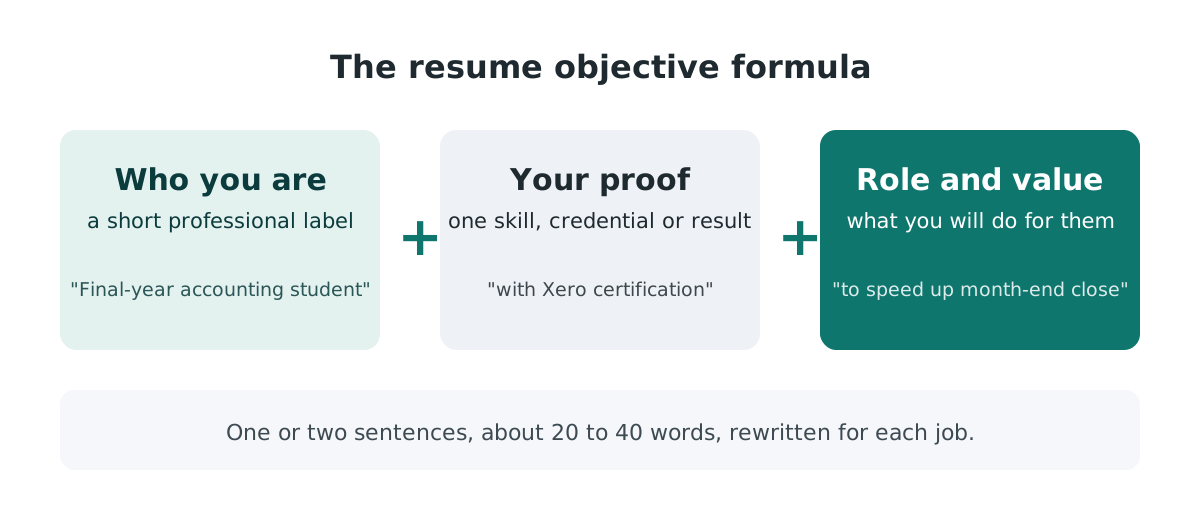
- Who you are. A short professional label: "Final-year accounting student", "Retail supervisor moving into HR", "Bilingual customer service agent".
- Your strongest proof. One skill, credential or result that matches the job ad: "with Excel and Xero certification", "who trained 12 new hires".
- The role and the value. Name the role (and the company if you can), then what you will do for them: "seeking a junior analyst role at [Company] to speed up month-end reporting".
Cal State East Bay also quotes an HR consultant's advice to "use keywords from the job description". That matters for software too. Applicant tracking systems (ATS, the programs that store and filter applications) match the words in your file against the job, and plain text in a normal section parses most reliably (Greenhouse support). So write the objective as ordinary text, not inside a text box or graphic.
Length is easy to check: one or two sentences, roughly 20 to 40 words. If yours runs longer, you are probably writing a summary or a cover letter. The cover letter is the right place for the longer story, and our cover letter generator can draft one that matches your objective.
Resume objective examples by situation
Use these as starting points, not finished lines. Replace the bracketed parts, swap in a real number where you have one, and mirror two or three words from the job ad.
Students and recent graduates
- Final-year marketing student with two campus campaign projects and Google Analytics coursework, seeking a marketing internship at [Company] to support social and email reporting.
- Recent computer science graduate with a capstone web app used by 300 classmates, seeking a junior developer role building and testing front-end features.
- Nursing graduate with 600 clinical placement hours across medical and surgical wards, seeking a new graduate registered nurse position at [Hospital].
- Education graduate with student-teaching experience in grade 4, seeking a teaching assistant role to support differentiated reading groups.
No experience or first job
- Reliable, punctual high school graduate with weekend volunteer experience at a food bank, seeking a part-time retail associate role with flexible evening availability.
- First-time job seeker fluent in English and Spanish, seeking a customer service position where clear, patient communication matters.
- Organized self-starter who managed a 40-member school club budget, seeking an entry-level administrative assistant role at [Company].
More of these, with full sample pages, are in our resume with no experience guide, and you can pair any of them with a cover letter with no experience.
Career changers
- Retail supervisor with five years of scheduling and training staff, moving into HR and seeking an HR coordinator role to support onboarding and employee records.
- Former teacher with a data analytics certificate and two portfolio dashboards, seeking a junior data analyst role at [Company] to turn reporting requests into clear insights.
- Hospitality manager transitioning to project coordination, bringing vendor management, budgeting and event delivery under tight deadlines.
Specific roles
- Customer service: Customer-focused agent with experience handling 60+ chats a day, seeking a support role at [Company] to improve first-contact resolution.
- Software engineer: Junior engineer experienced in TypeScript and automated testing, seeking a full-stack role on a product team that ships weekly.
- Graphic designer: Designer with a portfolio of brand and packaging projects, seeking an in-house role creating consistent campaign assets.
- Security guard: Licensed security officer with incident-report training and first aid certification, seeking a site security role with rotating shifts.
- Teacher: Certified teacher seeking a middle school science position to build hands-on, inquiry-based lessons.
Full sample resumes for these and other job titles, each with a matching cover letter, are collected in our resume examples hub. Applying for an internship rather than a job? The internship cover letter page pairs well with the student objectives above.
Career objective for a CV in the UK, Europe and Asia
If you are writing a CV rather than a US resume, the same idea usually appears under a different heading. UK guidance talks about a personal profile. Prospects describes it as "a concise statement that highlights your key attributes and helps you stand out from the crowd", and the National Careers Service says a CV should open with your contact details and "an introduction" (Prospects, National Careers Service).
In practice, a CV objective is a little longer than a US resume objective, often three or four lines, and it blends the forward-looking goal with a short summary of strengths. In India, the Gulf and Southeast Asia you will often see the heading "Career Objective" on many CVs, so using it there is perfectly normal.
Two conventions travel well everywhere: keep it specific to the job, and keep personal details out of it. The National Careers Service advises not to include "your age, your date of birth, whether you're married or your nationality". For a full walkthrough of the UK version, read our guide to the personal statement on a CV. If the word "CV" itself is confusing you, our explainer on resume vs CV sorts it out, and our CV maker sets up A4 and a profile section for you.
The common thread: whatever the heading, the objective works only when it is written for one specific job. Rewrite it for every application. It takes two minutes, and it is usually the first thing a recruiter reads.
Objective mistakes that make recruiters skim past
- Talking about what you want, not what you offer. "Seeking a role that will help me grow" tells the employer nothing about them.
- Being generic. If your objective would fit any job at any company, rewrite it.
- Using both an objective and a summary. Choose one opener.
- Making it a paragraph. Over two sentences, it stops being an objective.
- Putting it in a header, text box or image. Software may skip it entirely.
- Forgetting to update it. An objective naming the wrong company is an instant rejection.
A final contrarian note: an objective will not rescue a weak resume, and a strong resume rarely needs one. Spend most of your effort on the experience bullets. Our guide to writing a resume covers those, pick a layout from our resume templates, and the resume builder lets you try an objective, preview it live, and delete it if the page reads better without. Everything stays in your browser, there is no sign-up, and the PDF download is free.
Frequently asked questions
Should I put an objective on my resume?
Only if it helps. An objective is useful for students, first-time job seekers, career changers and people applying for a very specific opening. If your experience already shows your direction, use a summary or skip the opener.
How long should a resume objective be?
One to two sentences, roughly 20 to 40 words. Anything longer is closer to a summary or a cover letter.
What is the difference between a resume objective and a summary?
An objective looks forward to the role you want; a summary looks back at the experience you already have. Use one or the other, not both.
Are resume objectives outdated?
Not entirely. Career centers note that opinions vary and that objectives are less common than they used to be, but a specific, tailored objective is still useful when your direction is not obvious from your history.
What is a good career objective for a fresher?
Name your degree or training, one concrete strength such as a project, internship or certification, and the exact role you want. For example: "Recent accounting graduate with Xero certification, seeking a junior accountant role to support month-end close."
Is a CV objective the same as a resume objective?
The idea is the same. On a UK or European CV it is usually called a personal profile and runs a little longer, often three or four lines. Many CVs in Asia and the Gulf still use the heading "Career Objective".
Should I write my objective in the first person?
No. Resume convention drops pronouns. Harvard’s resume guide advises against personal pronouns such as I or We, so write "Organized graduate seeking..." rather than "I am an organized graduate".
Sources
- Millersville University Career Center: Resume and cover letter guide (PDF)
- NDSU Career Center: Ask the CC (objectives and summaries)
- Cal State East Bay Career Center: 30+ resume objective examples (originally published by The Muse)
- Harvard FAS Mignone Center: Create a strong resume
- Prospects: How to write a CV
- National Careers Service (GOV.UK): CV sections
- Greenhouse Support: Unsuccessful resume parse