Resume Meaning: What a Resume Is (and Is Not)
Show contents
- Resume meaning: a plain-English definition
- Where the word "resume" comes from
- Resume, résumé or resumé: spelling, accents and pronunciation
- What a resume contains, and what it leaves out
- Resume terms decoded: objective, summary, headline and more
- What "resume" means in a job ad
- Resume words that carry weight
The resume meaning most people are looking for is simple: a resume is a short document that summarizes your education, work experience and skills, which you send to an employer when you apply for a job. Cambridge Dictionary defines it as "a short written description of your education, qualifications, previous jobs, and sometimes also your personal interests, that you send to an employer when you are trying to get a job" (Cambridge Dictionary).
That one sentence hides a few surprises, though. The word has three accepted spellings, two pronunciations, a twin verb that sounds different, and a cousin called the CV. This guide unpacks all of it in plain English, then explains the jargon you will meet the moment you start writing one.
Resume meaning: a plain-English definition
Strip away the dictionary language and a resume is a sales sheet for your working life. It answers one question for a recruiter: "Can this person do the job we are hiring for?" Everything on the page should help answer that question, and anything that does not can usually go.
Harvard's career office calls it "a concise, informative summary of your abilities, education, and experience" (Harvard FAS Mignone Center). MIT's career center adds the reason it matters so much: your resume "is often an employer's first impression of you" (MIT CAPD).
Notice what neither definition says. A resume is not your life story, not a list of every task you have done, and not a legal record. That is the part people get wrong. When we look at first drafts, the most common problem is not bad writing; it is a document that tries to be complete instead of relevant.
In one line: a resume is a short, selective summary of your qualifications, written for a specific kind of job. "Short" usually means one page, and a second page only once you have the experience to fill it.
In British English the same document is usually called a CV. Cambridge marks the job-hunting sense of "résumé" as US English and lists "CV" as the UK equivalent. If you want the full comparison, including the long academic CV, read our guide to resume vs CV.
Where the word "resume" comes from
The word is borrowed from French. Wikipedia notes that "résumé" comes from the French résumer, "to summarize" (Wikipedia, Résumé). So the resume meaning is baked into the word itself: it is literally a summary.
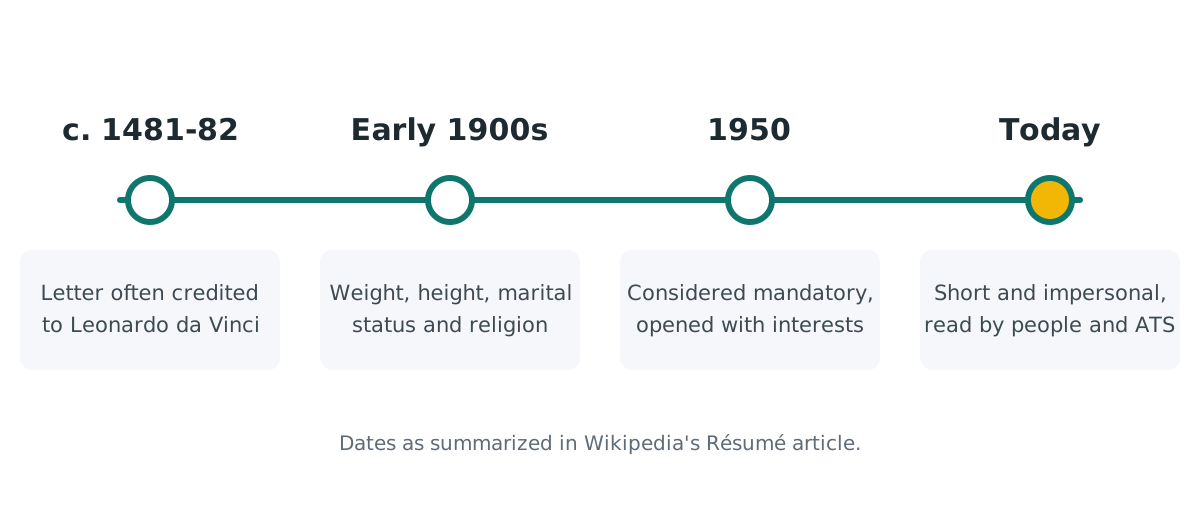
The document is older than the word. Leonardo da Vinci "is sometimes credited with the first résumé", a letter written around 1481 to 1482 listing his skills for a potential patron. Later versions looked very different from today's. According to the same Wikipedia summary, "in the early 1900s, résumés included information like weight, height, marital status, and religion", and by 1950 they "were considered mandatory and started with information like personal interests and hobbies".
Most of that personal detail has since dropped away. Harvard now lists "Include a picture" and "Include age or gender" among its resume don'ts. Modern resumes have also picked up a new reader: software. Applicant tracking systems (ATS, programs that store and sort job applications) read your file before a person does, which is why plain, text-based layouts matter more than they used to (Greenhouse support).
We find this history oddly useful. It reminds you that what goes on a resume is a convention, not a law, and conventions change. What stays constant is the purpose in the original French: summarize.
Resume, résumé or resumé: spelling, accents and pronunciation
All three spellings are accepted for the job document. Wikipedia opens its article with "a résumé or resume (or alternatively resumé)". The accents are there to stop you confusing the noun with the ordinary English verb "resume", which means to start again.
| Form | Meaning | UK pronunciation | US pronunciation |
|---|---|---|---|
| résumé (noun) | Job document; also a short summary of anything | /ˈrez.juː.meɪ/ (REZ-yoo-may) | /ˈrez.ə.meɪ/ (REZ-uh-may) |
| resume (noun, no accents) | Same as résumé; common in US job ads | Same as above | Same as above |
| resumé (one accent) | Same as résumé; accepted variant | Same as above | Same as above |
| resume (verb) | To start again after a pause | /rɪˈzjuːm/ (ri-ZYOOM) | /rɪˈzuːm/ (ri-ZOOM) |
Which spelling should you use? Our view: pick one and be consistent. "Resume" without accents is the most common form in US job ads and in software, and it is easier to type. "Résumé" with both accents is the most formal, and it removes any ambiguity in a heading. The one-accent "resumé" is correct but looks like a typo to many readers, so we avoid it.
A quick note on resume pronunciation in interviews: both REZ-yoo-may and REZ-uh-may are fine. The only version that sounds wrong is ri-ZOOM, because that is the verb.
What a resume contains, and what it leaves out
Knowing the resume meaning is one thing; knowing what goes inside it is what gets you interviews. A standard resume has five or six blocks, in roughly this order.
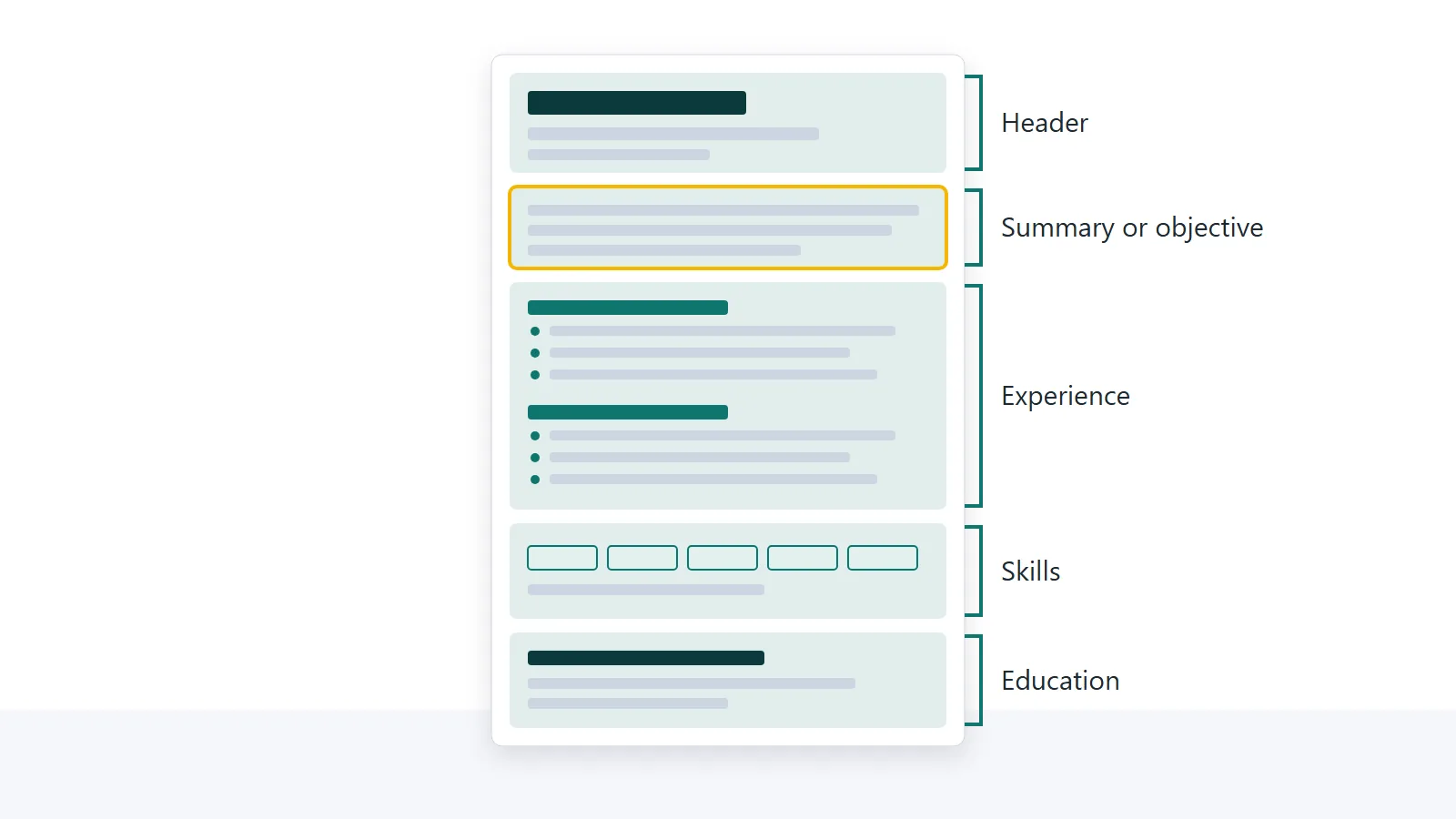
- Header: your name, phone, email, city and, optionally, a LinkedIn or portfolio link.
- Summary or objective: two or three lines that frame who you are. North Dakota State's career advisers describe the objective as an optional short statement at the top that "states what your reason is for applying" (NDSU Career Center).
- Experience: jobs, internships or volunteer roles, most recent first, each with results rather than duties.
- Skills: tools, languages and certifications that match the job ad.
- Education: degree, school and dates; near the top if you are a student.
- Optional extras: projects, awards, publications or relevant interests.
What to leave out matters as much. Harvard's "Don't" list includes using personal pronouns such as I or We, using a narrative style, including a picture, including age or gender, and listing references (our guide to references on a resume explains what to do instead). In other words, a modern resume is impersonal by design: short bullet points, past-tense action verbs, no life story.
If you want to see this structure filled in, our resume examples show it for real job titles, and the how to write a resume guide goes section by section.
Resume terms decoded: objective, summary, headline and more
Once the basic resume meaning is clear, the next hurdle is jargon. Job sites and career advice use a small vocabulary that is rarely explained. Here are the resume terms you will meet most often and what they mean in practice.
- Resume objective: one or two sentences about the role you want and what you offer. The objective meaning in a resume is "where I am heading". Our guide to the resume objective has examples.
- Resume summary: two to four lines about the experience you already have, the "where I have been" version. The objective guide above compares the two side by side.
- Resume headline or title: a single line under your name, such as "Bilingual Customer Service Lead". The meaning of a resume headline is a label recruiters can scan in one second.
- Chronological resume: experience listed most recent first. Harvard advises listing information "in reverse chronological order (most recent first)".
- ATS-friendly resume: a layout that software can read, usually a single column with standard headings. Read our ATS-friendly resume guide.
- Resume template: a pre-designed layout you fill in. Browse our resume templates or the classic Harvard resume template.
- CV or vita: in the US, a long academic record; Purdue says it is "also called a CV or vita" (Purdue OWL). Elsewhere, the everyday word for a resume.
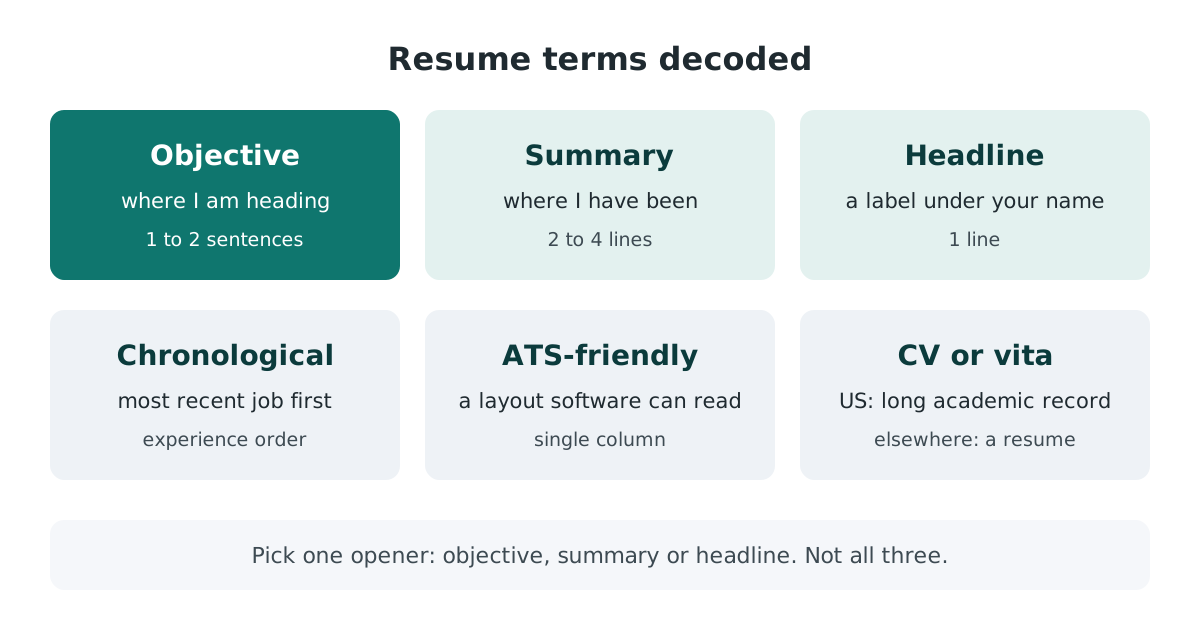
Here is our slightly contrarian note: you do not need every one of these labels on your page. A headline plus a summary plus an objective is three ways of saying the same thing. Choose one opener and spend the saved space on results.
What "resume" means in a job ad
In a job posting, the resume meaning narrows further. When an ad says "send your resume" or "upload resume", it means one specific file: the summary document described above, usually as a PDF or Word file. It does not mean your cover letter, an application form, or a link to a social profile, even though recruiters will often ask for those too.
It helps to see how the pieces of an application fit together:
- Resume: the facts. What you did, where, when and with what result.
- Cover letter: the argument. Why you, why this company, why now. Our page on the cover letter explains what goes in one.
- Application form: the employer's own questions, often repeating parts of your resume in fixed fields.
- Portfolio or references: proof, usually requested later in the process.
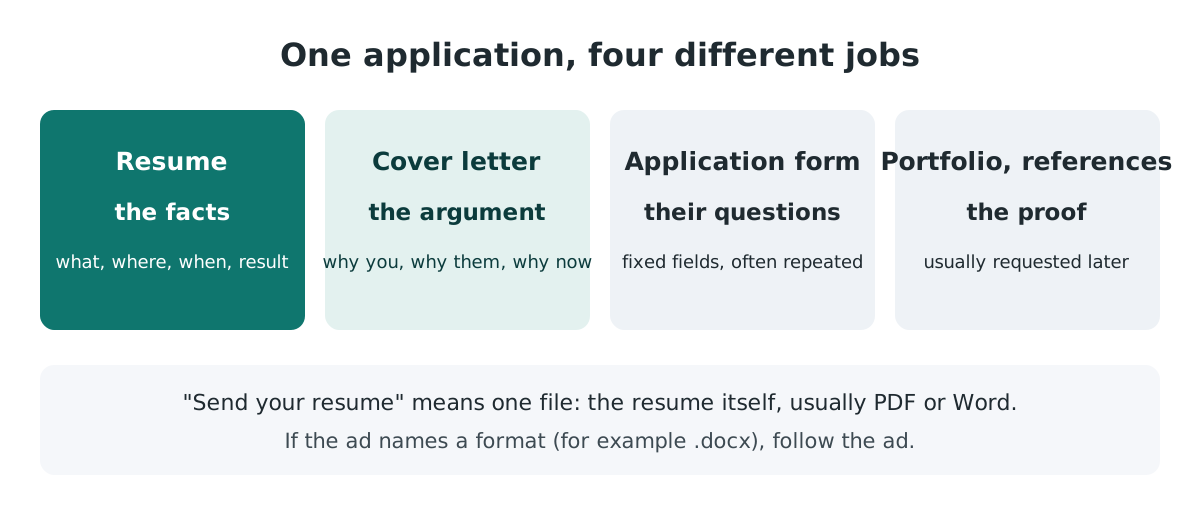
Two details catch people out. First, file format: the Greenhouse candidate FAQ tells applicants to "upload a PDF for best results", while the UK careers service Prospects warns that "not all ATS' are compatible with a PDF" and that some ads ask for .docx instead (Prospects). Read the ad and follow it. Second, "resume" in an ad for a job in the UK or Europe almost always means the short CV, not a long academic record.
Our honest opinion: what a resume means for a job is less about the document and more about the reader. A recruiter scanning a pile of applications wants to decide quickly whether to keep reading. A clear headline, recent experience first and numbers where you have them do more for you than any choice of font or spelling.
Resume words that carry weight
People searching for "resume power words" or a "resume synonym" usually want one of two things: other names for the document, or stronger verbs for the bullet points.
Other words for resume. The common synonyms are CV, curriculum vitae, vita (mostly academic, US), career summary and professional profile. In job ads, treat "resume" and "CV" as the same thing unless the role is academic.
Words for bullet points. Harvard's resume guide groups action verbs by skill, with headings such as leadership, communication and research, and warns against "using passive language instead of action words". A few examples by category:
| Skill | Stronger resume words | Example bullet |
|---|---|---|
| Leadership | led, coordinated, mentored, directed | Led a team of 4 volunteers to run a weekly food bank shift |
| Communication | presented, wrote, negotiated, explained | Wrote 30 help-center articles that cut repeat tickets |
| Research | analyzed, surveyed, tested, measured | Analyzed 2 years of sales data to find slow-moving stock |
| Results | increased, reduced, saved, launched | Reduced invoice errors by double-checking supplier codes |
The verb is only half the job. A strong bullet pairs an action with a result, ideally a number. Millersville University's resume guide makes the same point: "Use metrics and numbers to demonstrate your impact" (Millersville University Career Center). "Helped with marketing" says little; "launched a newsletter that reached 1,200 subscribers" says a lot, even if the number is modest.
When you are ready to put this into practice, the resume builder gives you a live preview while you write, the CV maker handles A4 and UK conventions, and the cover letter generator drafts a matching letter. All three run in your browser, need no account, and export a text-based PDF for free. Moving on from a current job at the same time? The resignation letter tool uses the same editor.
Frequently asked questions
What is the meaning of resume in English?
In job hunting, a resume is a short written summary of your education, qualifications, work experience and skills that you send to an employer. As a verb, "resume" means to start something again after a pause.
How do you pronounce resume?
The noun is pronounced REZ-yoo-may in British English and REZ-uh-may in American English, according to Cambridge Dictionary. The verb is pronounced ri-ZOOM.
Is it spelled resume or résumé?
Both are correct, and so is resumé with one accent. "Resume" without accents is the most common form in US job ads. Pick one spelling and use it consistently.
What is another word for resume?
Common synonyms are CV, curriculum vitae, career summary and professional profile. In the US, "vita" or "CV" usually refers to a longer academic document.
What does objective mean on a resume?
A resume objective is an optional one or two sentence statement at the top of the page that says what role you are seeking and what you offer. It is most useful for students, career changers and first-time job seekers.
What is the difference between a resume and a CV?
In the US and Canada, a resume is a short job document and a CV is a long academic record. In the UK and most other countries, CV is simply the everyday word for the short job document.
How long should a resume be?
Usually one page early in your career. MIT advises sticking to one page unless you have extensive experience or an advanced degree, in which case a second page can be justified.
Sources
- Cambridge Dictionary: résumé
- Wikipedia: Résumé
- Harvard FAS Mignone Center: Create a strong resume
- MIT CAPD: Resumes
- Purdue OWL: Writing the Curriculum Vitae
- NDSU Career Center: Ask the CC (objectives and summaries)
- Millersville University Career Center: Resume and cover letter guide (PDF)
- Greenhouse Support: Unsuccessful resume parse
- Greenhouse Support: MyGreenhouse FAQ for candidates
- Prospects: How to write a CV